Author Archives: janet

Identity and Place – Part Five Exercise 3: ​Your Journey

Brief

Your journey may not involve travelling the world or an excursion across Russia, but you might see your journey to the post office every Monday as particularly relevant – or the journey from your bed to the kitchen in the morning.

  • Note the journeys you go on regularly and reflect upon them.
  • Now photograph them. Remember to aim for consistency in your pictures. If you choose to photograph all the charity shops you’ve visited in a week, try to photograph them all using the same camera, lens, standing position, lighting, etc. This will help keep your project honed to the subject matter rather than you, the photographer.

My first Journey

I have been spending quite a bit of time at the dentist lately and as a nervous patient I try to reduce the anxiety by focussing on other things on my way there! I am fortunate that it is within walking distance so it gives me time to try and relax both on my way there.

I wanted to highlight the fact that I am focusing on things that I probably wouldn’t focus on if there wasn’t the need to keep my mind off the dentist chair.

My second Journey –

On reading the brief for this exercise, I had just returned from a trip to Italy by car. During the trip down I had taken hundreds of shots for the previous assignment. We have undergone this trip quite a times before, so I had a general idea of what the countryside and buildings looked like as passed from the UK, through France and down from Northern to central Italy.

When looking through the the images, I was quite taken by the way in which it depicted our journey almost in movie terms as I flicked through each shot. I was of course looking for the shots that I needed for the previous assignment but it wasn’t lost on me that I had recorded our journey in the images whilst taking individual images for a specific assignment.

Many of the images were taken from the passenger seat of the car whilst on the move. So in essence I only had a fleeting glance at the landscape I was shooting, although because the camera has in effect frozen the moment I could have been there for much longer as far as any viewer was concerned! Could I say I had “visited”these places? Did I just pass through? or more truthfully I just passed by. On many occasions I passed by very quickly and the scene was only in view for a second or so. For anyone not knowing the context, many of the images could have been taken whilst I was actually there and not in a fleeting moment. The other thing that occurred to me was that for the most part I would not have been able to say exactly where the images were taken. I could generally say what country they were in and generally at what point in the journey but without checking the route and then the date and time on the images themselves, I would not be able to map them out. So not only wasn’t I there for anything but a few seconds, I actually didn’t even know where there was! This really does not come across in some of the images. It does look like I was there for a while and that these place meant something to me. Why would I take them if not?

I selected images that had nothing in them to suggest I was on the move or in a car. Or images that I could crop to remove any such indicators. I think it worked well and my fleeting moments certainly could be viewed as static “I was standing there taking the photo” images. They look very much like snaps taken on holiday whilst visiting particular places of interest. Not images taken on the move in a car.


Identity and Place – Part Five Assignment Five: ​Planning and Creation

One of the things I find myself using a great deal whilst out and about with my camera is benches. I sit on them to have a rest or to sit and watch, hoping perhaps for that “decisive moment” In a previous exercise where we were asked to spend an hour sitting watching and taking notes, I did some of this from a bench that I’m very familiar with. I, like many other people would assume that most park benches are located in places that have particular purpose. In a shopping centre, so people can take a break from shopping, outside a place of work so employees can relax during their lunch or tea breaks. Outside hospitals so relatives can wait or grieve. In places of beauty, facing the sea, on a clifftop, facing a park or facing a historical house and garden. There are some benches that seem to have been placed in strange locations or they have been usurped by other structures that have been built without the realisation of the fact that the bench will lose its appeal.

Often there is a plaque dedicated to someone or even sometimes sometimes someones pet. I will always take time to read it. I do tend to try and imagine what they were like and why the dedication is in this particular location.  I’m not sure if I would like a bench dedicated to me after I’m gone but with the amount of time I spend sitting on them these days maybe I should!

It’s sometime tricky to find a free bench here in the city in the summer and there seems to be some unwritten rule about sharing a bench with a stranger. May be if there is one person and  at one end, then it might be acceptable to sit at the other. Covid has made that less likely so I often find myself passing benches that I would otherwise taken advantage of. A bench with no-one on it, is to me, a thing of great beauty and opportunity.

Putting these thoughts together I wondered if I could create series of images of benches that have a sense of human existence without any people present?

Benches are very much objects that are specifically there for the purpose of sitting on. An empty bench is one that has been sat on and will be again. It is a sign that we exist. The fact that we often label a bench with a particular persons name and other personal details,  tells us, not only did that person exist but we want them to live on in the people who sit on the bench, and those who take the time to read about them.

I did wonder how similar these plaques were to headstones or memorial plaques in a cemetery or memorial garden. The fact that there are often remains in the ground or ashes, in a cemetery or memorial garden is one difference, although people may spread ashes at the location of a bench, with or without a plaque.  Of course there are many memorial benches in cemeteries. What they do have in common however is that they are a place for mourning and remembrance.

The need to remember loved ones is important for most of us and different cultures have different ways of doing this. We like to see the persons name, perhaps the date they were born and the date they died. We will often put a little bit of extra information about them relating to family members or something important to them. When to comes to benches; quite often, the reason that the bench was important to them may also be mentioned. The fact that most people using the bench won’t take the time to read a plaque or won’t know who the person is, doesn’t seem to be important. The fact that is is there and that when the persons loved ones see it, they feel that the person has not been lost and is, in some way is still with them. In other words they just haven’t been forgotten.

I want the benches to be empty so the images can fire the viewers imagination. So – I began with some research on “Emptiness’ in images and other photographers who have used this idea in various ways.

Emptiness (Research)

Ward Roberts (Research)

Francesco Margaroli (Research)

Chris M Forsyth (Research)

I also came across a  series called Bench by Yeveniy Kotenko. The same bench, different people.
He took photographs of the bench from the same window over a period of time capturing the seasons and the people. He had no intention of creating a series when he started. This is almost the opposite of what I want to create Different benches – no people. Trying to counjour up an image of all those different people through the benches.
Bench by Yeveniy Kotenko.

I want to try and get each image to conjure up a different type of person or people. If I can match that with the plaque then that would be an added bonus. But I may have to forget about the plaque if it seems to be working without. The back ground and the bench itself is going to be quite important. I want to try and trigger the viewers imagination in a particular way to get them thinking about who may have sat on the bench in the past and who might sit on it in the future.

My first camera task is to go out and find some benches with or without plaques and judge if this really can be an assignment piece! I also need to work out how close or far away I need to be in order to get the effect that I want.

I managed to find quite a few benches, both with and without plaques. (Images 1- 7)

I tested various view points and framing.

Image 1 and 2 had some context in shape of the cans. There have obviously been some people there drinking, who have now abandoned the bench and their empty cans.

Images 3-5 had a sense of emptiness which I really liked. This came across better in image 3 as there was more empty space around it. The litter to the right if the frame gives us a sense that there have been people there.

I quite liked image 6 because of the path behind it. Leading people to and away from the bench.

I included image 7 in these test shots because of the purple blossom to the left of the frame. The blossom and the plaque made me think that the persons loved ones might see the blossom as something special next to the bench.

A few more shots, viewpoints and angles

Image 8, has lots of space making the bench look very isolated. Not quite what I wanted and perhaps too isolated and far away?

Image 9, has signs of life (I liked the chunky bench too)

Image 11 has the bridge in the background, could this bench be used by families and walkers. It looks very rural from this angle.

Image 20, I decided to take some that included the view that anyone sitting on the bench would get. This bench looks like it needs an elderly person or couple on it enjoying the view of the water. I have no idea why an elderly couple? Perhaps something from my past?

Image 16, although not strictly a bench, definitely gives the impression of more than just a sit down. They are picnic tables, there are two of them and there is quite a substantial refuse bin next to them. There is definitely an expectation here of some kind of “picnic”

Image 25, gave me the impression that someone had just got up and walked away out of sight down the path. I included paths in the shot on several occasions, hoping that this might give the impression of someone having just left and wandered away.

A couple more shots

I am still interested in the idea of having a path visible that people are coming and going from. (Img. 27) This one is also interesting because there the 2 benches very close to each other. Are the for a specific reason? Are there going to be different groups who have a connection to each other sitting on these benches?
Image 28 was interesting because of he initials carved in it. Not sure quite what this says? It certainly looks a well used bench!

These shots were taken during a period of nice weather so don’t fit very well with the previous shots. I will take these again if I can when the light is not so strong and there is a bit of cloud cover.

Next time I went out,  I took some shots with people in them. I wanted to try and compare a shot with and without people. In light of the research I had read relating to the presence of people I wanted to see if this was obvious. (see below)

In a study, Sussman and the writer Janice M Ward, found that

“When tracking the eye movements of subjects looking at one image of Boston City Hall and its surrounding plaza, people spent more than half of the time allotted to look at the image examining the other tiny, speck-sized human beings rather than the architecture” 

Emptiness

As suspected, having people kin the shots changed them completely. The bench becomes almost invisible and my attention was immediately drawn to the people. Once my eyes had scanned the people, I did look around the frame and there were other things to look at. However had I am sure the benches would not have been one of them.

Images 33, 38 and 47 stood out for me in this set.  Image 33 because my eye was down to what ever a person sitting on this bench might be looking at. Image 38 and 47 because they are nestled in the hedge. These look like benches that you might sit on if you wanted a bit of privacy. I will leave them for a day or so and come back to them with fresh eyes.

I find it so much easier to see what’s what after leaving them for a day or so. I cut them down to ones I thought would fit with my series idea as a starting point for the final set. I also don’t have a number of images in mind.

I cut them down again. (Below) Really trying to think about how they work with each other and trying to ensure that each image is saying something different in relation to the space and the “people” who have gone before and in the future. I left them for a day or so, just in case but I am happy with these as my final images.


Identity and Place – Part Five Assignment Five: ​Your Inspiration

Brief

Look back at the themes we’ve examined relating to place and our presence within it. What areas inspired you most?

The culmination of this course is a self-directed assignment where you have free rein to choose a subject that relates to any of the material discussed in the course. You may have gathered skills and insights through the projects that you want to revisit or you may have been inspired by other ideas.

The only stipulation is that the final outcome must represent a notion of identity and place that you are personally inspired by. Make sure that your work is visually consistent, relevant to the subject matter you choose and holds together well as a set, both visually and conceptually.

Think carefully about your editing decisions.

  • Which images need to be there?
  • Which ones repeat other images?
  • Are you holding on to a favourite that is no longer required?
  • Do you need to re-shoot anything?Aim for a coherent set of no more than 15 pictures, accompanied by a reflective commentary of no more than 500 words.

Planning and Creation

Introduction and reflective commentary

I realised looking back at some of my previous assignments and exercises that I have, on several occasions chosen to represent “people” through objects. And that I was trying to illicit some kind of emotion from the viewer. I’m not sure I was always conscious of trying to to that but looking back it does indeed seem to be what I was looking for. (Img. 1-3 )

Image 1 using the lighting, empty bed and other objects to create a tension relating to the whereabouts of the person who was in the bed.
Image 2 A glimpse of a shirt through the wardrobe door
Image 3 Representing my mums last year of life.

Img. 1

Img. 2

Img. 3

The idea for the benches came about due to the fact I find myself sitting on them quite a lot. Taking photos from them, resting after wandering the streets taking photos or just plain people watching. I find myself looking for empty benches and this can be a task in itself during busy months. I have met a few very interesting people while frequenting these benches and it made me think about how I could represent the different people who have sat on and will sit on these various benches in the past and in the future. I did wonder at first if I should try and incorporate the plaques that are sometimes present on the benches, but some of them had very traumatic and sad histories behind them so I decided not to.

I really wanted to try and cause the viewer of the images to start to imagine the different sorts of people who might come and go from the benches and perhaps imagine themselves sitting there and what they might see.

My research into “emptiness” and some photographers who use this idea, helped me to really start to understand how different a landscape can be when it is devoid of life. We are so tuned to picking out people that we rarely take much notice of the rest of the scene if there are people in it. We certainly look for and search for people over and above everything else. I wasn’t aware I was doing that, but I definitely do. Even in my own images, when I’m trying not to! Another series by Yevgeniy Kotenko portrayed the wide variety of people frequenting a single bench over a long period of time.

Research Emptiness

Research Ward Roberts

Research Francesco Margaroli

Research Chris Forsyth

Research Emin and Taylor

Research Yevgeniy Kotenko

Final Assignment Images

Img. 47

Img. 46

Img. 16

Img. 33

Img. 13

Img. 3

I had no real understanding of the effect having people in or missing from an image could have? I was also sure at the beginning that the plaques on some of the benches would play a part in the assignment, but they did not seem add anything to the series, or fit in any way that was helpful. I do however wonder of they could contribute to a different series in the future. I was worried that the images might all be a bit similar – a bench after all is just a bench, and the Cambridge “council” benches all seem to be the same. I did include some different ones, but I’m happy to say, not just to make the images different. I thought that the surroundings and other clues would be the way to make this work and to a certain extent I think it has. I was surprised at how the angle or the direction a bench was facing made such a different to what it might say. Once again, as with most of the assignments I have done, I think this is a project that would benefit from more time and thought and something that I may come back to.

The research that I did into the work by Yevgeniy Kotenko was something that I wanted to look at in more detail. I managed to find the location of the bench on google earth and it appears to be in a bombed area of the city (I can’t be sure about that so don’t take my word for it) The current situation in the Ukraine is extremely bad and want to wish Yevgeniy, the bench, his parents and their apartment and the people featured in his series and all the people of the Ukrainian my thoughts and prayers for a peaceful end to this madness!

Identity and Place – Part Five Reading Task: ​Something and Nothing

Brief

Read Chapter 4, ‘​Something and Nothing’ ​in Cotton, C. (2014) The Photograph as Contemporary Art (3rd edition) London: Thames & Hudson. You will find this on the student website.

  • To what extent do you think the strategy of using objects or environments as metaphor is a useful tool in photography?
  • When might it fall down?

Write some reflective notes on these points in your learning log.

Using objects or environments as a metaphor in photography can be extremely powerful and can give the viewer a very unique, intimate, and emotional response. It allows for interpretation and contemplation.

with this type of work, the practitioner fosters our visual curiosity by subtly and imaginatively encouraging us to contemplate the stuff of the world around us in our daily lives in new ways.(Cotton, 2009)

I sometimes find it hard to determine what some images are trying to say, unless there is some form of explained to hand. I wonder sometimes if  a reflection on me or the image. I guess it can be a bit pf both at times. I do think that sometimes  I am looking for a “rhyme or reason” where perhaps there is none. The photographer had their reasons but those reasons may not be something that the viewer sees or is even expected to see. All images have a reason (of sorts) behind them. I still find some images a bit pointless,  and have to admit sometimes that I “just don’t get it” I am happy for the time being to wait to see if this evolves into a deeper understanding.


Bibliography

Cotton, C., 2009. The photograph as contemporary art. London: Thames & Hudson, p.115.


Identity and Place – Part Five Exercise 2: ​Georges Perec

Brief

The French writer Georges Perec wrote a book called An Attempt at Exhausting a Place in Paris (​ 1975) in which he wrote down everything he could see from a certain viewpoint. You may like to read it.

A further work by Perec is entitled ‘​Species of Spaces and Other Pieces’​, the first chapter of which attempts an interesting classification of spaces, ranging from the page itself to world and space outside. Again, this might help in relation to the following exercise.

Choose a viewpoint, perhaps looking out of your window or from a café in the central square, and write down everything you can see. No matter how boring it seems or how detailed, just write it down. Spend at least an hour on this exercise.

Here are some areas to consider:

  • Can you transform this into a photography version? –
  • Would you stay in the same place or get in close to the things you listed? – in the same place as I think some context would be important.
  • Would you choose to use your camera phone in order to be discreet or would you get your tripod out? – I would be discreet so as not to change the behaviour of any people in the shots.
  • Would it be better in black and white or colour? – It would have to be in colour to capture the variety of attire
  • Would you include your list with the final images? – yes, but i would try and make it less if a list and more a piece of writing 

You may choose to turn this into a photography project if it interests you.

I really enjoyed reading Perec’s book “An Attempt at Exhausting a Place in Paris” and it wasn’t what I thought it was going to be. There was far more detail such as

“A man with a large A on his sweater”

and comments, or internal narratives such as

“Buses pass by, I’ve lost all interest in them”

I am currently reading “Species of Spaces and Other Pieces”.

I also came across an interesting series by a Ukrainian photographer Yeveniy Kotenko who didn’t set out to create something particularly worthwhile but ended up doing just that and more. Bench by Yeveniy Kotenko

I decided to log this exercise in a similar way to George Perec

Date: 1st June 2022
Time 11:40
Location: Retail Park
Weather: Cool (cold even) windy and cloudy

  • Large shops and shop windows.
  • Car park and tarmac with arrows and double yellow lines.
  • Small  trees panted between some of the parking bays.
  • Trolley bays.
  • Pedestrian walkways and pedestrian crossing.
  • Overweight man in his late 60s? on the phone outside a sports shop with a small overweight dog on a lead.
  • Very overweight teenager coming out of sports shop wearing vest, shorts and trainers.
  • White VW camper van cuts corner coming into car park.
  • Bald man cycles by on fold up blue bike.
  • A red transit van parks outside the bike shop.
  • It is particularly cold considering it is June!
  • Woman in winter coat and wearing scarf (its not that cold).
  • Woman in her 50s running – bright pink fluorescent socks.
  • The tags on items by the shop doors are being blown about and are fluttering in the breeze.
  • A Middle aged asian couple walk by. He has a baseball cap on and shins pulling a red shopping  trolley.
  • Lots of cars, vans and lorries coming and going, reflected in the large shop windows.
  • Very very overweight young girl with pony tail and very short flared skirt rides by on a bike.
  • Abandoned shopping trolleys have been pushed or blown by the wind into corners.
  • A family walk in a line separate from each other all doing their own thing – young girl on tricycle, young boy on his phone, mum on her phone, dad looking in shop windows.
  • Blue Deliveroo bike parked outside bike shop.
  • Middle aged woman with red helmet and red scarf goes into a chemist shop.
  • Young woman with back pack and mask dances around while unlocking her bike – perhaps she has earbuds in and is listening to music?
  • Older woman and young  boy walk past. Both are wearing stripped tops. Are they grandmother and grandson?

In Perecs book he describes people having only one hand free a lot of the time and this is the same here. (No one with a baguette in the retail park though)

  • Phones, bags, carrier bags, bottles, cigarettes, vapes, packets, boxes, holding a childs hand etc.
  • Heavily made up woman parks her white car right next to me. False eyelashes, thick foundation and bronzer, red lipstick and mauve coloured hair.
  • Middle aged woman in red jacket, bright yellow coulottes and black ballet pumps walks by.

The clouds are a mix of white fluffy and dark grey stormy. There are little pockets of blue here and there and when the sun pops through it is possible to feel the warmth.
There is a sound of hammering coming from somewhere, cars and people talking.

Date: 1st June 2022
Time 12:10
Location: On way from Retail Park to Park Ice rink
Weather: Cool (cold even) windy and cloudy

  • Three men drinking something from cans on a couple of benches. One of them is half asleep and looks like he may fall off the bench at any moment.
  • Bus stop with a woman and child waiting at it. The woman is trying to fold a buggy up
  • Wires going up from the ground to starlight dishes on houses. More wires carrying, telephone signals or internet or electricity, snake their way above, up and down on and between the shops and houses
  • Postman in shorts with his head down pushing a trolley full of letters and parcels
  • Stopping at some lights I realise that I am sitting next to a large green generator. I can hear it humming, even with the window closed

I have sat at these lights so many times before and never noticed the generator!

  • Plane taking off from the small airfield on the other side of the shops and houses.
  • Drive through blood testing. People sitting in their cars, waiting for their number to come up
  • Some chatting, some on their phones, some just staring out of the window, some snoozing
  • Birds signing and pigeon cooing. Only just conscious of this.
  • Kids chatting and excited about going skating.
  • Adults trudging along – not so excited
  • White seeds floating in the air like snow. Every now and again they float through the car.
  • Bollards scattered around inside the blood testing tent, as if they are expecting a stampede
  • Man in his late 30s with wild hair and a beard wearing a jumper, shorts and sandals, gets into a very old car with his two children. The car has moss growing round the windows
  • Litter has been blown into corners of the car park, cans, crisp packets and paper
  • A magpie browses, looking for valuables
  • It hops and jumps its way across the road to some unseen treasure


Identity and Place – Part Five Exercise 1: ​Still Life

Brief

● Create a set of still-life pictures showing traces of life without using people.

You could do this with your camera phone to reflect the vernacular and transient nature of these moments or you could choose to use high-quality imagery to give these moments gravitas, like Nigel Shafran.

● Your technical decisions should back up your ideas, so write a short reflective commentary detailing these decisions and the reasons for them.

I found inspiration for the images in this exercise from my partner. He is one of those people who always leave a trace of being somewhere (particularly at home) This is not a complaint or a moan, just a statement. He leaves cupboards and drawers open, he leaves shoes and slippers wherever he takes them off. He gets things, uses them but rarely puts them back where they came from. He walkespast things that he could pick up, like empty cups and mugs, but just doesn’t see them. I sometimes comment on it, but to me it means he is here. These are signs of him being here, even when he’s not. We have both recently turned 60 and have been together for 20 years. I am aware that one day either he will have to live on without me or I will have to live on without him. The thought is terrifying, and I know if it me that is left, I will be wishing he was here leaving his stuff around. I would be desperate to see signs of him still being with me and want to see open drawers and cupboards. So – while he is here with me I shall treasure it all.

I decided to use a point and shoot type camera on auto, to reflect the fact that I am just taking the shots as and when I see them while going about our normal daily lives.

I have to admit, looking at a few of there made me quite sad! Particularly Figure 5 (the shoes).


Identity and Place – Part Five Assignment Five: Research – Chris Forsyth

Chris M Forsyth

Chris M Forsyth is a photographer and bookmaker from Canada.  He says about himself and his work

“Through my research-based practice in photography and bookmaking I explore the complex and overlapping relationships we have with place. In projects linking themes of history and human geography, I approach landscape as a layered archive. My work revolves around the varied ways in which we have come to define and redefine our surroundings–ranging from the monumental to the personal–and what our interventions ultimately suggest about ourselves in return” 

His series Metro works really caught my eye. The colours are rich and deep and not what I was expecting at all. For me these are beautiful works of art. You really have to examine some of them closely to determine what they really are. I wonder if they would have been as striking if they had people in them. Judging by the science, it sounds like people would have been an initial distraction that may not have allowed me to see them as I am now.

Metro Works (2014 – 2018)

The one that fascinates me is the one with five seats up against a bright orange wall. I suspect this has to do with my assignment subject being empty benches! I almost want to see someone walk along the platform and sit down in the middle seat! Why the middle seat? – my need to keep things tidy!

Bibliography

Available at: https://www.chrismforsyth.com/metro-works
[Accessed 27/05/2022]

Identity and Place – Part Five Assignment Five: Research – Francesco Margaroli

Francesco Margoli

Francesco Margaroli is a self taught Italian contemporary photographer

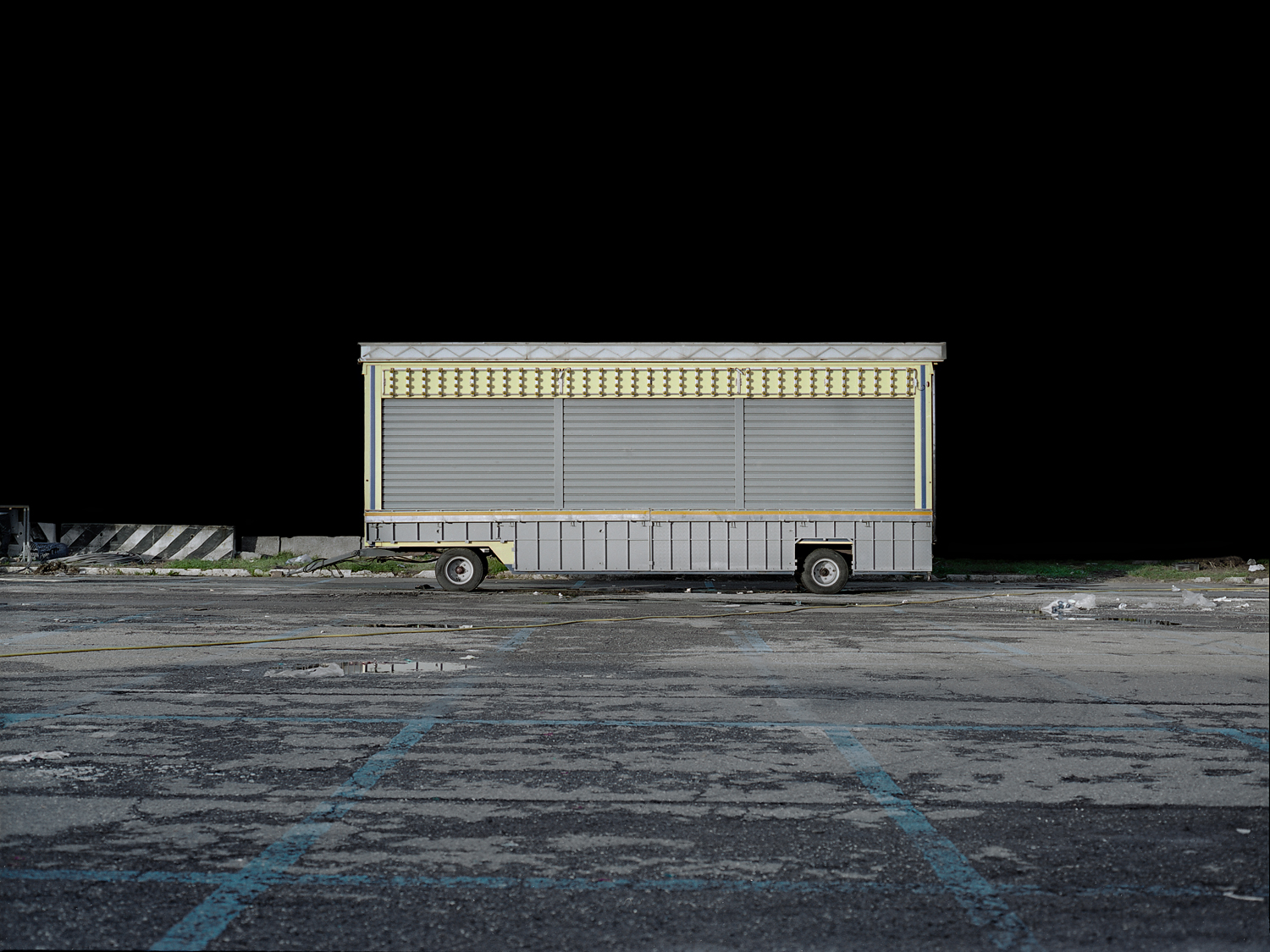
His series Nowhere and Nowhere 2 are images of abandoned or empty fun fairs and once again the fact that there are no people present make them even more present!

“If you photograph an absence, you also reveal the presence.” Margaroli, F (nd)

I find these images fascinating to look at and once again find myself imagining the people that have gone before and the people that might arrive in the future.

“I think that a photograph must tell a story. The story contains a message, a concept, fully interpretable by those watching the photograph. But a reaction of “wow, cool” is well accepted” Margaroli, F (nd)

In an interview, Margaroli was asked what photography meant to him, he replied

“Photography is the medium I choose that helps me to interpret reality. Reality sucks? Then photography helps me to escape, to transmit, to represent” Margaroli, F (nd)


Bibliography 

https://www.fastcompany.com/3062926/why-do-we-love-images-of-empty-spaces-neuroscientists-and-artists-explain

Figures 1-11
Available at:https://artofcreativephotography.com/contemporary-photography/interpreting-reality-francesco-margaroli/
[Accessed 28/05/22]


Identity and Place – Part Five Assignment Five: Research – Ward Roberts

Ward Robers

Ward Roberts is a New York based artist.

 “drawing on themes such as the effects of loneliness and isolation in the modern world”

“the artist’s perspective is fresh and engaging, the sophisticated aesthetic are often contradicted by subtle unscripted moments. a soft drenched colour pallet is a common theme. there is an innate energy at the core of his work, one which is harnessed and marshaled into every detail in the composition. Robert’ work is in many ways a rebuttal of the prevailing trend of urban, gritty style contemporary photography. there is a dichotomy at play in his fine art images which simultaneously recall the mastery of medium and calculated patience of remote academic painters, yet his subjects and presentation feel completely new and contemporary”

In his series Courts 2 he took images of basketball courts in various countries around the world. The colours are beautiful, the harmony a surprise. Are these colours and harmonies accidental or planned by the architect? Would we have seen such works of art if there had been a player on court or a game in progress. Roberts himself stated

“At the very beginning of the series, I shot a few images with someone playing on the field, and it just didn’t feel right,” he wrote. “It didn’t work. It broke up the composition and it felt visually distracting. In my work, I hate what I call ‘the full stop,’ which is when you look at an image and there’s one element that attracts all of your attention. It becomes the only thing that you can focus on.” Roberts, W (nd)

Although there are no people in these images, without doubt we are enticed to think about them. We can see them in our minds eye, on the court or looking out of the windows watching a game or daydreaming. I feel that these imaginings are made all the more romantic buy the images themselves and the softness of the colours that may have been missed had the images included actual and not imaginary people!

Bibliography

Ward Roberts photoessay
Available at: https://www.dezeen.com/2016/07/24/ward-roberts-pastel-coloured-basketball-courts-photo-essay/

Figures 1 – 8
Available at: http://www.ward-roberts.com/courts2
[Accessed 28/05/2022]

Identity and Place – Part Five Assignment Five: Research – Emptiness

Images with or without people!

Why I can images of mundane normal everyday things be investing. Are we down to images with people in more than images without?

There are so many photographers that take images of “emptiness” By that I mean images that seem to have nothing much ion them. No people, nothing of any great interest, yet they are compelling! Why?

Rudy Vanderlands a dutch photographer and graphic designer says

“My images are empty of people but they’re littered with the traces of human enterprise, To me, they’re anything but empty.”

Fig. 1 Lancaster, California, Rudy VanderLans

The traces of human enterprise might be the key here. Are we looking for the human element in every image even when there isn’t a person in view?

It’s possible that if there is a person or people in the image then it detracts from what else is there. We tend to focus on the person or people.

Ann Sussman who is the co author of Cognitive Architecture: Designing for How We Respond to the Built Environment suggests that

“In a sense, once people are in a shot, we can’t really ‘see’ the place for what it is,”
“Our brain, because of its evolution, will not let us do this.”

In a study, Sussman and the writer Janice M Ward, found that

“When tracking the eye movements of subjects looking at one image of Boston City Hall and its surrounding plaza, people spent more than half of the time allotted to look at the image examining the other tiny, speck-sized human beings rather than the architecture” 

When researching some of the photographers that create images without people in them, and in particular architectural images I was blown away by several of them and in particular those of  Chris Forsyth and his series of empty metro stations.

Fig. 2 Chris Forsyth Metro Works (2014-2018)

Chris Forsyth (Research)

Edmund Burke an Irish philosopher may have described feeling I, along with many others have had when inside large open spaces such as churches, cathedrals and theatres. Particularly when there is no one else there . In 1757 he published  an idea called “the sublime” Along with other ideas it deals with the thought  that we can be overwhelmed by the human presence in vast empty spaces even when there is no-one there.

“Vessel posited that large empty spaces like cathedrals or civic buildings can provoke this kind of reaction. Images of such spaces, similarly, may require the brain to imagine a space of such magnitude that the senses are perceptually overwhelmed. “There’s a representation in our head that’s trying to capture and represent the size of the space,” he says. “It might be that we’re representing the size of a space we’ve never been in. We’re creating a mental model of something very large and that sometimes also contains us.

Those sometimes take our breath away because they give us a moment to contemplate the history or the potential or the way that people might move through those spaces,” Vessel says. But something more vast than the space itself? The thousands, perhaps millions of human echoes–the impressions and memories and forgotten tidbits–that space has contained through its lifetime. If an image of an empty place can capture that, it may have caught the sublime itself” Burke, E  (1757)

Other photographers that have created images specifically without people to enhance the visual of the space are

Ward Robert (Research)

Francesco Margaroli (Research)


Bibliography

Figure 1
Available at: https://www.fastcompany.com/3062926/why-do-we-love-images-of-empty-spaces-neuroscientists-and-artists-explain
[Accessed 27/05/2022]

Figure 2
Available at: https://www.chrismforsyth.com/metro-works
[Accessed 27/05/2022