Category Archives: Context and Narrative Part One

Assignment One: Two sides of the story – Reworked Submission

Coming back to this assignment I  found that some of the things my Tutor said to me during our feedback meeting had stuck in my mind both in relation to the objects used and the feel of the images which I displayed in black and white. We also discussed putting some examples of entries from my mums diary in the assignment. I decided to focus on these three aspects as I felt they were vital in moving forward with this project. I did of course take into account all the feedback given.

I stated that the reason I used black and white was because the “objects stood out better”. At the time this seemed like a good reason! In hindsight I now see that is most defiantly is not and has changed the feel of the images to something I didn’t want – “cold and detached” which is in fact  the opposite of what I wanted. I need to illicit a warmth from the images that better suggest the relationship with my mother in those last 12months. I also need to make sure that everything in the frame is adding to my intent or certainly not taking away from it.

The objects I used were a mix of her original things which I still have and treasure, some of my own items. My tutor suggested watching a Ted Talk by Robert Bloom in relation to the value we ascribe to objects. A fascination insight and a really enjoyable talk. I realised that the objects I had used were a bit of a miss match of “real”,  “symbolic” and “replacement” which I feel is contributing to confusion in relation to what the series is about.

I found that selecting Diary entries ended up being far more difficult than I imagined! I love reading them now but trying to decide which ones to include was a very different matter. I am aware that few people will read the blog but I feel it is important for me to remember how proud, dignified and private she was and that she is not able to give her consent.

One entry that stuck me as central to the series was the one where she writes:

“Saw Dr. Parkes – gave me the bad news – couldn’t do crossword either!!! Still no heart scan. Didn’t sleep well
PULMINARY FIBROSING ALVEOLITIS”

This was the day that she found out about her terminal diagnosis. It also happened to be Friday the 13th (March 1998). Throughout her illness, the crossword was our way of judging how she was. How much oxygen she was getting could be determined by how quickly or how much of the crossword she was able to do.  The first real symptom of her illness was breathlessness. These words started to appear in the Diary entries in late January, just over a year before she died.

Thursday 29th January 1998
“Jessie came to coffee & we talked & talked!!!

Kathy phoned
feeling a bit off  V. breathless”

Up until the end of January 1998 her entries didn’t mention feeling breathless. She spent time shopping, having coffee with friends, going to music recitals and generally having quite a nice time.

Wednesday 21st January 1998
Music Society – Duo,
Clarinet &Guitar
Campbell Duo – he’s a Scot
Gas Boiler Service – morning
Jessie to coffee
Vio & I to Music Society – V.good
Vio back to supper. Good evening

The phrase “V. breathless” appears in nearly all of her entries up until the diagnosis. They had supplied her with oxygen in Feb/March so this helped. She doesn’t mention the crossword much in any of her entries other than the one in the entry on the day of her diagnosis. I don’t believe she was aware of her inability to finish it as she was often too poorly to realise. It was more a signal for her family and friends that something was wrong.

Working through these thoughts and observations I realise that the breathlessness/oxygen and the crossword were far more important than I realised. It is also clear that my communication and interaction with my mum increased greatly as the year went on and that prior to her illness we had a what I would consider now a normal amount of interaction between Mother and Daughter. We were in essence both just “doing our own thing”. What was “our own thing” changed greatly as her illness progressed.

How do I show our lives progressing over those months? Instead of trying to get to the final set of images immediately, I am going to take it slowly and work through it and try to get more of a feel or what I want. A pointer that my tutor gave me for Assignment Two was to “try and take your work through more cycles – more reflection and subsequent shooting” I think this is great advice and although I may not have time to create the same number of images for this re submission of the assignment, I think it’s an effective approach for my progression.

Starting from before her diagnosis, which was January/February and the beginning of March. Her life was quite full with things such as doing the crossword (with no problems), having coffee with friends and shopping. I wasn’t physically in her life a great deal but we would talk about once a week on the phone.

Some thoughts for images to represent the time prior to diagnosis:

Crossword (completed)
Coffee pot and cups/mugs
Telephone (in the back ground)?

Some thoughts for images to represent the time after diagnosis:

Crossword (not completed at all or partially completed).
Empty Crossword tied up with some tubing to represent the breathlessness/need for oxygen, that was stopping her from being able to do the things that she could before.
Telephone more in the foreground.

Apart from colour my tutor also mentioned the tablecloth that I had used. This was a tablecloth that belonged to my mother and I wonder if a colour image using the same table cloth would come across warmer. Rather than changing the table cloth entirely. The glasses I used also belonged to my mother and thinking back to the TED talk I am aware that these are an object that is valuable only to me. I’m also aware that if I used a completely different pair of glasses that didn’t belong to my mother and providing they weren’t obviously too modern, that anyone viewing the image would be none the wiser. It would be interesting to know if it would make a difference to how the image is perceived if people thought all the objects were hers or only the glasses and the table cloth.

I started with a some test shots as below to try and get a feel for where I was going with it all. After cutting them down to a set of six, I felt that Image ….56, (Fig.1) stood out for me. I am trying very hard to work out why,  and for the reason to be more than “it appeals or it looks better”. It has to be because It helps the story or the narrative. I see the crossword as important, (foreground) symbolising her time before diagnosis and coffee pot/mugs symbolising the normality and social side of her life at that time. I realised that the tablecloth is not showing in this image anyway!

Fig.1 I

I had started with an image that depicts her life before her illness so I thought I would go straight to the image(s) which would depict her life at the peak of her illness and the weeks prior to her death. I am currently not thinking about images to depict my life and our converging lives during that time, but will come back to them once I have a clearer vision.

Test shots done and after a bit of a cull of shots that really didn’t work, was left with what i think are the best six.

Image …..63 stood out for me from these shots. More disorganised that the initial shots, the image looks flatter and less interesting than Fig.1 which certainly reflects this time in her life. Most of the crossword has been left blank apart from the word breathlessness at 17 across. I included some medication in this one. We discussed her coming off some of the medication that she was taking. Often her tablets were very difficult for her to take or chew and some of them really were pointless considering her terminal diagnosis.

Fig.2

Thinking about the whole issue of her breathlessness, I had completely ignored the fact that towards the end of her life her world revolved around getting enough oxygen and all the physical and mental anguish that this involves. I decided therefor to represent this with some transparent rubber piping which , until we had an oxygen system properly installed, trailed itself after mu mum wherever she went bot inside and outside the house. It literally became her lifeline.

Once again I cut them down to a final six. Image …..73 stood out for me, putting the oxygen and crossword, which she still tried to complete and by this time usually failed,  in the foreground.

Fig.3

In September she started taking half a sleeping tablet, which, according to her diary was a bit hit and miss as to whether it worked or not. Her diary for the last few months always started (or ended with the words “half a pill” followed by the resulting good, bad or mixed nights sleep. I think this needs to be represented in the final image. She was told on so many occasions that she could take a whole tablet, which would probably give her a good nights sleep, but she said that she didn’t want to get addicted! None of us had the heart to tell her that she didn’t have enough time left for that. With this in mind the next image will be just the oxygen line and half a tablet or a pile of half tablets. I am still not thinking about how I might incorporate the other side of this story – my side – but I’m finding it useful not to try and think about both sides at the same time.

I wasn’t thinking about the back ground so decided to replicate the images using the tablecloth as a continuous background. In other words, no distracting background. I also used a couple of small lights to help to remove shadows and a good reflector to try and put a little bit of warm across the images. I also warmed the images up in photoshop but I actually think it has given them an impression of being in black and white and old!

1

2

3

4

I found myself looking at the last image and realised that it really struck a cord with me in reflecting my mums last few weeks. There is a feeling of emptyness, loneliness and sadness about it. Her life was all about getting enough breath and sleeping at night so that she didn’t think too much and was more likely to have a better day. I wonder if this means that I have at least one image that is saying what I wanted it too? I don’t have time to complete 2 sets of images as I did for the original submission, and I think it has been far more productive for me to concentrate on trying to get some aspects of a few images right, than another whole set of images that are rushed and don’t say what I want at all.

Assignment One: Reflection and Feedback

Note: (Having just finished part one and then having given part two (Narrative) a quick look I wonder if this assignment fits better with this section!)

My first thoughts after completing this assignment were that I don’t yet have the skills or the knowledge to do the subject justice. But, I do believe I have taken a huge step in my ability to move into a more conceptual way of thinking.

With hindsight I am not sure that my response to this assignment precisely fits the brief, but once I had come up with the idea I wasn’t able to come back from it. The two sides of this story are both true, but the observer could take something completely different from without the context.

Some of the things I learned:

  • I was surprised that visualising the images mounted on a wall before I had actually picked up my camera, helped to inform and visualise what I felt the images should contain and look like.
  • I hadn’t attempted any type of hanging plan or style pf presentation thus far in the course and this is  a new and welcome addition to my image making.
  • Knowing when to stop! I had so many different ideas in the end that trying to apply them all would have really started to disrupt the concept. I wanted it to be “deep” but “simple”
  • Focus stacking in Photoshop to get a sharp image whilst using a wide aperture.
  • What I had learnt in a previous exercise (Street Photography) when considering the benefits to the series of colour or black and white. In the past, I would have made the decision between black and white and colour, purely on aesthetics
  • The value of research in providing inspiration and nudging curiosity.
  • To take more organised notes during the planning process and make sure I jot down ideas rather than thinking I will remember them.
  • To keep scribbles and sketches to include in my blog.
  • Having the diary really helped fire my imagination and I found it so useful to have something to use as inspiration.

This was a challenging project, but one that I feel has shown that I can come out of my comfort zone. I do have concerns that I have strayed too far from the brief and have overlapped into part two, but I will wait for Tutor feedback to answer that one!

Tutor Feedback

Overall Comments

  • Despite your worries about fitting the brief, this is an interesting, albeit difficult subject to work with. Personal experiences are what helps to make individual and meaningful work but also can create problems of objectivity.
  • Some pertinent research that sets up your visual strategy well 

Demonstration of technical and Visual Skills, Quality of Outcome, Demonstration of Creativity

  • I am not concerned about how much or little this fits the brief, this is fine.
  • Although the act of creating a tableau is, of course, a construct, there is something about these sets of images that feels very cold and detached, is this deliberate?
  • Is it sensible to use the same objects in each set? If you don’t have her actual things any more, could you search out similar items to use for her set? This could be interesting in terms of the relationship between documentary photography and truth, in that the viewer would be asked to decide if it is ok to use ‘props’ instead of actual object. Could you also have chosen a different table cloth? Background?
  • Without actually seeing the colour versions, I don’t necessarily agree with you about the brutal removal of colour. You said, ‘Objects stood out better in black and white? – really, what does this mean? And this may be true in terms of a formal account of the pictures but what you also do is remove the potentially different characters depicted by the differing sets of images.
  • It would be good to see some examples of entries form your mother’s diary – if that is ok with you emotionally. I was interested to read about the way that your life gradually began to feature more heavily as time went on – is this something that you could explore through these images?
  • You did some good research around the history of still life, as well as a more contemporary look at the genre but please be careful that you do not try to transplant meaning from one era to another. You said, ‘symbolise feelings and other abstract concepts’ – be careful particularly given the different way that images are read in different times – an extreme example perhaps but the swastika or a more contemporary symbol, the facemask? Different cultural epochs render different meanings to different objects – is this something that you could utilize in your work? Could you choose different objects from your’s and your mum’s own eras that have slightly different meanings in different times? Beware, specifically of using clichés like clocks – unless this is part of your visual thesis. For example, I could look at those objects and they would have very different associations,–
    • Watch – fitness, I use my apple watch to stay fit during lockdown
    • Small bunch of keys – the problems that my son has with anxiety
    • Whiskey glass – American movies

Coursework

Demonstration of technical and Visual Skills, Demonstration of Creativity

This looks fine, good to see you persevering with experiments that you don’t particularly enjoy!

Research

Context, reflective thinking, critical thinking, analysis  

  • Some good stuff here and it is clear you understand the use of symbolic object.
  • Now you need to think about extending this research to a more analytical phase to bridge the gap between this and your own visual experiments.
  • Remember also that your own experimentation is part of your research process.

Learning Log

Context, reflective thinking, critical thinking, analysis  

  • Could you start a completely different word press blog?
  • We’ll have a proper look at this when you have new blog in place.

Suggested reading/viewing

Context

Ted Talk – Robert Bloom in relation to the value we ascribe to objects.

https://www.ted.com/talks/paul_bloom_the_origins_of_pleasure?language=en

Pointers for the next assignment / assessment 

  • Work on your analysis and reflection, think further about the images you are making as well as those that you are researching.


Assignment One: Research – Contemporary Still Life Photographers

Still life photographers

I had decided that I didn’t want the images to be in the style of the “Old Masters”. I find them quite dark, depressing and the religious connotations don’t fit with the meanings, and feelings I was attempting to convey.

I looked at the work of several photographers, creating pin boards of images that struck a chord with me. I decided to have a closer look at the work of a few of them and selected: Irving Penn, Martin Parr, Marian Drew and Laura Letinsky, all of whom have produced work that I felt might be inspirational for my images.

Irving Penn:

Born 1917 Penn, an American photographer is well known for is still life and fashion photography, working for many famous brands such as Vogue and Clinique. His images have echos  of the symbolism used by the old masters,  but not often in the same style. (Fig. 1-3)

“He made still life for use as editorial photographs for Vogue, as advertising photographs for various companies, and for himself…… Penn produced a number of still-life photographs celebrated for their elegance and clarity. He switched between black and white and color as called for by the objects at hand, and his diverse subject matter included food-stuffs, human skulls, animal bones, flowers makeup, luxury goods, and detritus found in the gutter” (Martineau, 2010)

Several aspects of Penn’s images seemed pertinent  to my “story”.  I had started to consider composition at this point, and found the style of Fig. 2 the most appealing, which I have no doubt has something to do with the composition and the tone. The lack of colour gives its calm, even, feeling without any single aspect grabbing too much attention.

Martin Parr:

A British photographer born in 1952, and known for his photojournalism around the subject of everyday life in England, although he also travelled extensively and took photographs around the world. His still life’s often feature food and everyday objects which again echo back, at times,  to the symbolism of past paintings. His use of images to portray something that may look like a snap shot of someones “dinner”, but is in fact expressing a serious and far more meaningful concept, is one of the reasons I chose to take a closer look at his work.

‘I make the pictures acceptable in order to find the audience but deep down there is actually a lot going on that’s not sharply written in your face’, Parr has said of his practice. ‘If you want to read it you can read it” (Parr, N.D)

“What the wily photographer is in fact doing is transforming his viewer into a kind of subjective judge; as we try to unravel the image, guessing the location, the occasion and the class of its subject, we are simultaneously creating a narrative about the characters in it, based on their snack of choice” (Seymour, 2016)

Although many of the images I examined were centred around food, he also included a wide variety of people, places and other seemingly everyday subjects in his work. I did notice the tablecloths in some of his shots which provided and indication of the location of the shot and therefore the nationality of the food itself, particularly in Fig.1 (British) and 2 (Mexican).

Marian Drew:

Australian photographer Marian Drew’s work has a strong suggestion of the tradition of painting symbolism as suggested by Dr Marcus Bunyan in 2011

“Drew’s tabletop still life compositions feature fruits, vegetables, and dead animals and birds presented as game. While the unusual angles and lustrous colours bring to mind paintings by Paul Cézanne, the richness of the fabrics and dramatic lighting look back to 17th-century examples. Road kill gives Drew’s photographs a dynamic twist that calls into question mankind’s stewardship of the earth and it’s creatures.” (Bunyan 2011)

Drew says of her work

“With this work I aim to bring actual and specific deaths to our attention and to acknowledge their close links to the sustainment of our lives. Through a process that aims to honour the specific through the verisimilitude of photography and the general through formal, ritualistic frameworks of kitchen and the historical genre of still life painting, I hope to promote a sense of gratitude, respect and responsible awareness to  ‘other’ animals as well as to ourselves.” (Drew N.D)

There is also an element of surprise in Drew’s work. We would not normally expect to see a dead bird in a kitchen today, on a table or in a bowl. It was not clear if her use of fruit, such as lemons and game are included as symbols in their historic traditional sense or if they are being used as symbols personal to Drew.

“The lemon has come to symbolise many opposing ideas – while it’s considered a symbol of luxury, love and longevity, it’s also emblematic of sourness and disappointment. The lemon is bittersweet: its beauty at odds with the sharpness within. Of all the icons in the still life scene, the lemon is the most favoured. Its appeal was both to the artist, as a chance to display their skill – and to the patron as an opportunity to demonstrate their sophisticated tastes” (Marks, 2020)

“Like all representations of meat, game and shellfish, the lobster is most commonly thought to symbolise wealth, gluttony and temptation” (Marks, 2020)

I noted again the use of tablecloths, and napkins, which in this case add to the incongruity of the dead animal or bird placed on them.

Laura Letinsky:

Canadian born still life photographer Laura Letinsky moved from photographing people to photographing objects in the late 1990s. Her work resonated with me more than any of the other images I had researched so far. Her placement of objects seemed to be saying something about the passing of time and items about to fall off the table about endings. The idea of objects moving further away as they become less important to my mother and closer as they become more important was an interesting idea to consider for my sets. Tablecloths featured heavily too!

“Letinskys photographs appear to be about loss, reminding the viewer of the ephemeral nature of life in a different, and perhaps more subtle way than has been done previously” (Martineau 2010)

There were two images in particular that I felt were likely to influence the style and composition of my sets; Irving Penn’s still life (Fig. 2 New York Still Life New York 1947 Platinum) and Laura Letinsky’s still life (Fig. 19 Laura Letinsky, from the series Hardly More Than Ever, 1998).


Bibliography

Martineau, P., 2010. Still Life In Photography. Los Angeles, Calif.: J. Paul Getty Museum, p.13.

Figures 1-6
Penn, I., n.d.
[online] The Irving Penn Foundation.
Available at: <https://irvingpenn.org/still-life&gt;
[Accessed 28 October 2020]

Seymour, H., 2016. Martin Parr’s Unusual Take On International Cuisine. [online] AnOther. Available at: <https://www.anothermag.com/art-photography/8534/martin-parrs-unusual-take-on-international-cuisine&gt;
[Accessed 28 October 2020].

Art Fund. 2015. Martin Parr: Museum Of The Year Finalists In Pictures. [online] Available at: <https://www.artfund.org/blog/2015/06/30/martin-parr-museum-of-the-year-finalists-in-pictures&gt;
[Accessed 28 October 2020]

Figures 7-12
Parr, M., n.d.
[online] Magnum Photos.
Available at: <https://www.magnumphotos.com/&gt;
[Accessed 28 October 2020]

Bunyan, M., 2011. Marian Drew Lorikeet With Green Cloth – Art Blart. [online] Art Blart.
Available at: <https://artblart.com/tag/marian-drew-lorikeet-with-green-cloth/&gt;
[Accessed 28 October 2020]

Figures 13 – 18
Drew, M., n.d.
[online] Slate Magazine.
Available at: <https://slate.com/culture/2013/02/marian-drew-photographing-still-lifes-of-dead-animals-in-australia-photos.html&gt;
[Accessed 28 October 2020].

Martineau, P., 2010. Still Life In Photography. Los Angeles, Calif.: J. Paul Getty Museum, p.14.

Figures 19-24
Letinsky, L., 1998-2014
[online] Yanceyrichardson.com.
Available at: <https://www.yanceyrichardson.com/artists/laura-letinsky/featured-workds?view=slider#17&gt; [Accessed 28 October 2020].


Assignment One: Planning and Creating the series (Two sides of the story)

I decided to produce two sets of five images. One set to represent my mum’s year;  going from her being unaware of her future diagnosis, the moment immediately after diagnosis, the period where she was coming to terms with it, living with it and then the time just before her death. The other set to represent my own version of  the same year going from living my own life with a mum who lived 2 hours away, was independent and who I saw fairly regularly but who’s life was very different to mine. I wanted the images to represent the way our respective lives changed as the year progressed and the way in which we became closer.

I could visualise the images on a wall and I could see them coming very subtly closer together as time went on. (Fig. 1) (Exaggerated offsetting to remind me.)

Fig. 1

Visualising the images helped me to inform the style and the composition. I could see my mums set getting gradually getting darker from the first to the last with objects changing their position to reflect their relative importance in her life. And some objects moving from her set to mine to express the increasing closeness and closure.

Fig. 2

The objects and their symbology

Set One – My Mum’s

  1. Watch – Time – limited time.
  2. Small bunch of 2 keys – symbolising independence.
  3. Glasses – active, independent.
  4. Whiskey glass – A glass seems to symbolise different things but there is a reference to them. symbolising  “the overthrow of worldly achievements by death” Slowly emptying
  5. Flower – Symbolising life.
  6. Petals (leaves) falling – Her health declining as she moved towards death.
  7. Tea Pot and cup/saucer – The move away from precious possessions.
  8. Diary-  Only in the first 4 images – then it moves to my set, (final image).
  9. Books – Knowledge – still a need to learn
  10. Christmas tea light  (moves to my set in chapter 5) the passing on of traditions after death.

Set Two – Mine

  1. Books: – Work and study – there are less books in the later images due to less time being available.
  2. Grater and Lemon:  domesticity – caring for my son
  3. Large bunch of keys: Busy and independent
  4. Flower: symbol of life
  5. Watch and Clock: Busy
  6. Mums Diary in image 5: Keeper of her possessions
  7. Christmas Tea Light: Creating own tradition
  8. Additional Tea Light in final image: Continuing tradition and joining of traditions.
  9. Phone – communication
  10. Cup and saucer – moves from Set 1 to Set 2 final image – her possessions now move to me.

Reviewing the images that I looked at for inspiration, I picked out three to focus on whilst creating my sets;


I initially used a glass table with a slightly scrunched up crochet tablecloth and a light underneath, to give a bright, almost ethereal look, with the background wall kept dark with a shadow pattern being thrown on it through the tablecloth from the light. But I found the  pattern too distracting . I used a smaller light coming from the left to reduce the shadows on the objects. At this point I hadn’t come to a decision about composition, preferring to allow this to evolve with the test shots.

I wanted all the objects to be in sharp focus, and took 4 test shots (Fig. 6 – 9) with different areas in focus. This allowed me to keep the aperture wide. I used photoshop to stack and blend all the shots into one (Fig. 10). This worked well and was another Photoshop first for me.

Fig. 10 Blended image, with all required area in focus

After some deliberation I changed the tablecloth as I was finding it too distracting and I felt it really wasn’t adding anything to the images.
I took a whole series of test shots, playing with different objects and positions, and a different table covering. As this was very much experimental, I chose to do this without a memory card, reviewing the images quality on screen. I only started to capture the images once I felt things were worth deeper review.

The next set of test shots worked quite well, but I needed to fix a “falling forward’  issue that was noticeable on the coffee pot glass and cup, by rotating and cropping the images. The result wasn’t ideal as the flower was then too close to the top and caused tension.  (Fig. 11,12). I was basically happy with the composition and the objects themselves, but the changing light needed to be more subtle. The main light source was still natural light and so I decided to try taking the shots at 15 minute intervals, starting at 16:00, to capture the fading winter light. In the end i found adjusting the exposures in Photoshop gave me more effective control.

Final test Set

In a previous exercise we were asked to take colour and black and white shots and then review them. Looking at my test shots, I asked myself what the colour was doing for the images in relation to what I was trying to represent. The orange of the flower certainly caught the eye but this didn’t  add to the meaning. Turning them black and white gave the images texture and depth and although I can’t pin down exactly why, seemed to express more of what I’m trying to say.


Assignment One: Research – Symbolism in Still Life Photography

Symbolism in Still life photography

I didn’t know very much about this subject but I suspected it would fit well with my idea. I needed a way of representing the last 12 months of my mothers life, using her diary as the guide to what those days were like and how they changed over the subsequent months. At the same time I would symbolise my own life over the same time period as it drew closer to hers. After some thought I decided that a selection of objects might be a good way of expressing this and so started looking at Still Life Photography

Symbolism in still life photography appears to have its roots firmly grounded in the old masters of the 16th and 17th century.

“Burnt candles, human skulls, dying flowers, fruits and vegetables, broken chalices, jewellery, crowns, watches, mirrors, bottles, glasses, vases… Today, we can see them in the works of still life photographers, but more notably, these were the typical, prominent feature of the paintings created by the Dutch and Flemish Old Masters of the 17th century” (Kordic, 2016)

A symbol did not always symbolise the same thing, as it often depended on the painter or indeed the religion and education of the viewer. For example;

“Devout Catholics meanwhile would recognise in the careful spacing of Zurbarán’s quietly meditative Lemons, Orange and a Rose a reference to the Holy Trinity” (Pound, 2018).

 Osias Beert, a Flemish painter used fruits such as strawberries and cherries to depict the souls of men (Fig. 1).

Fig. 1 Osias Beert (c.1580-1623) – Still Life with Cherries and Strawberries in Chinese porcelain bowls

The use of symbols, it seems,  was not just for fun!

“……when the Dutch Reformed Protestant Church made it illegal to depict any religious icons in art. That meant that if an artist wanted to talk about anything to do with religion (which was pretty much the hot topic back in the day) they had to get clever. And so, everyday objects became codes for things you weren’t supposed to be talking about with a paintbrush…” (Knapp, 2019)

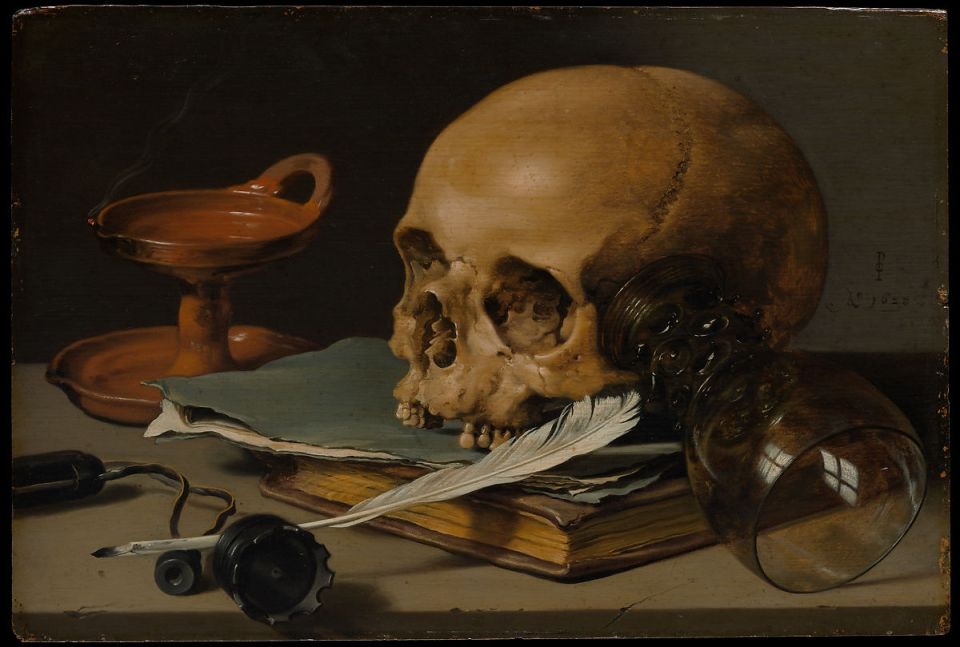
The word Vanitas kept popping up in my research and having never come across it before. I looked it up in the Tate glossary where it is described as,

“A still life artwork which includes various symbolic objects designed to remind the viewer of their mortality and of the worthlessness of worldly goods and pleasures” (Vanitas – Art Term. Tate, n.d.)

Figure 2 Pieter Claesz – 1628

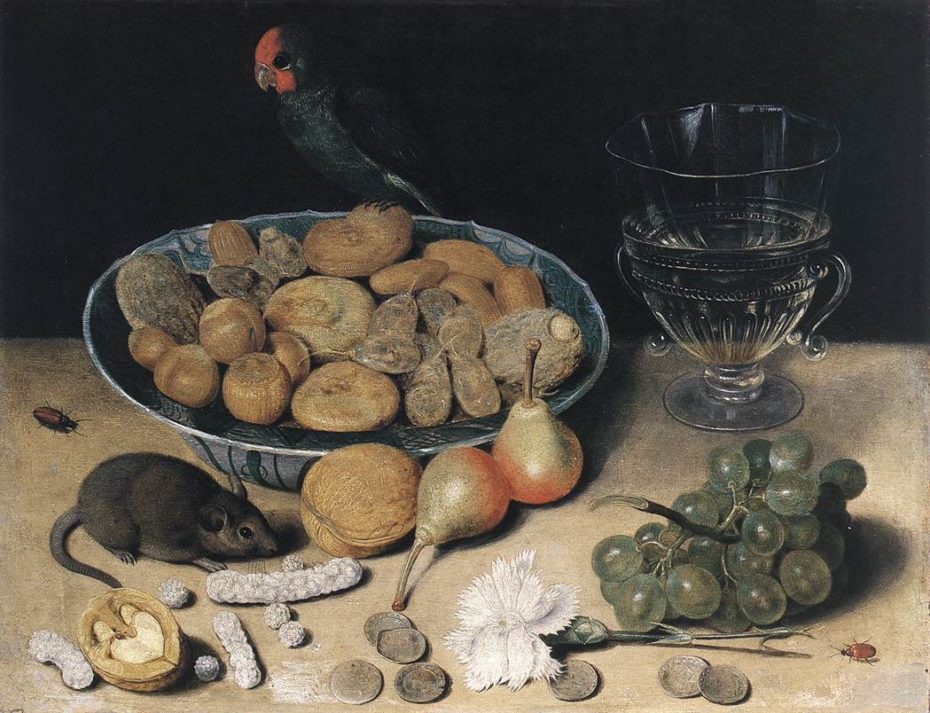
Another artist using symbolism at around the same time, was the Dutch painter Georg Flegel. His still life below (Fig. 3) is an absolute cacophony of symbolism; in fact there isn’t anything in it that doesn’t appear to have a symbolic meaning. The cross is represented by the walnut, Holy Communion by wine and grapes, Jesus by a white flower, Judas (betrayal) by the coins. The nuts were being guarded by a bird rather than the mouse who, being on the ground, is seen as closer to satan. In the words of the author;

“It was basically a Bible School cheat sheet” (Knapp 2019)

Fig. 3  Georg Fegel Dessert Still Life (first half of 17th century)

It had already occurred to me that I would have to be very careful in selecting the style of images. On looking at the Old Masters, I became very aware of  light and shadow and the challenges this might bring to the technical side of the shots. Looking further at contemporary still life photography, it was clear that this very challenge was often the inspiration itself;

“One of the most interesting and challenging aspects of this genre of painting and the reason why many still life photographers are attracted to it is the chance to explore the composition and lighting, probably much more than the topic of vanity itself. Because the medium of photography relies on light so heavily, still life of this kind provides a vast field of technical experimentation – in the manner of the Old Masters, still life photographers create the perfect contrast between deep shadows and penetrating light which highlights only certain objects” (Kordic, 2016)

Many of the images seen in contemporary still life photography bear a strong resemblance to the style of the old masters, in the subjects or visual countenance. In Figure 4 Krista Van der niet, a Dutch still life photographer has chosen items of food and butterfly’s, often found in the old masters but has; apart from the black background, given the image a very different look by her choice of lighting.

Fig. 4 Krista van der niet (N.D)

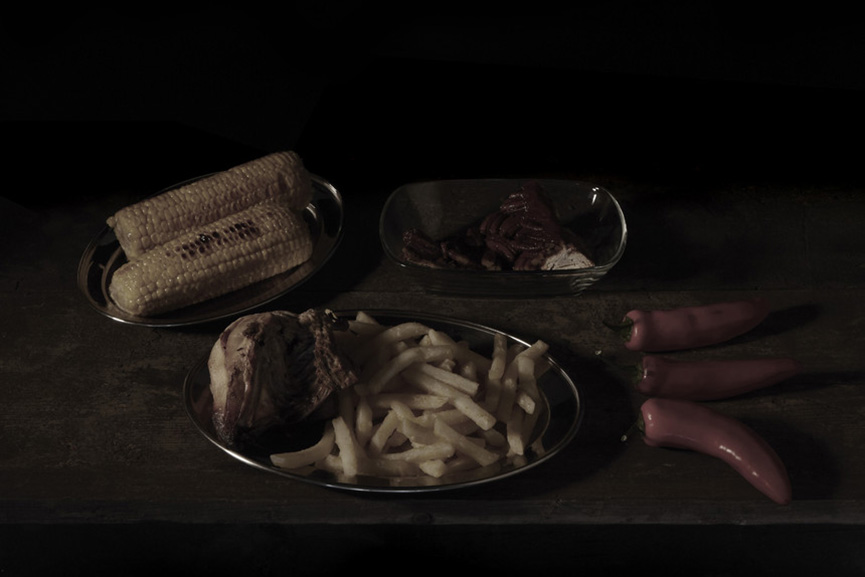
In Mat Collishaw’s series Last Meal on Death Row (2011) , (Fig. 5) he has incorporated food, and the style of lighting and composition used in the 16th and 17th century. There was quite a dark theme behind the series and this is reflected in the overall look of the images. Collishaw recreated the last meals eaten by prisoners on death row and states,

“I remade the meals in a manner usually used for reflecting on the accumulation of worldly goods, vanity and mortality,” Collishaw (N.D)

Fig. 5 Mat Collishaw. last Meal on Death Row (2011) – Paul Nuncio

Having discovered a whole wealth of information relating to the symbolism used in painting and often incorporated in still life photography, I needed to look closely at how I am going to express this in my own mages.

I moved on to look at some still life photographers and their work in order to get further inspiration. (Link)


Bibliography

Pound, C., 2018. Secret Symbols In Still-Life Painting. [online] Bbc.com.
Available at: <https://www.bbc.com/culture/article/20180318-secret-symbols-in-still-life-painting&gt;
[Accessed 26 October 2020]

Figure 1
Available at: <https://www.bbc.com/culture/article/20180318-secret-symbols-in-still-life-painting&gt;
[Accessed 26 October 2020]

Kordic, A., 2016. Still Life Photographers Who Give A Fresh Meaning To Vanitas | Widewalls. [online] Widewalls.ch.
Available at: <https://www.widewalls.ch/magazine/still-life-photographers&gt; [Accessed 26 October 2020]

Knapp, F., 2019. The Secret Language Of Still Lifes. [online] Messy Nessy Chic.
Available at: <https://www.messynessychic.com/2019/04/05/the-secret-language-of-still-lifes/&gt;
[Accessed 26 October 2020]

Figure 3
Flegel, G., (first half of 17th century). The Secret Language Of Still Lifes. [online] Messy Nessy Chic. Available at: <https://www.messynessychic.com/2019/04/05/the-secret-language-of-still-lifes/&gt; [Accessed 27 October 2020]. 

Figure 2
Claesz, P., 1628. [online] Metmuseum.org.
Available at: <https://www.metmuseum.org/art/collection/search/435904&gt;
[Accessed 27 October 2020].

Tate. n.d. Vanitas – Art Term | Tate. [online]
Available at: <https://www.tate.org.uk/art/art-terms/v/vanitas&gt;
[Accessed 27 October 2020]

Figure 4
Van der niet, K.,
Available at: http://www.kristavanderniet.nl/portfolio/arts-holland-magazine/#1
[Accessed 27 October 2020]

Figure 5
Collishaw, M., Last Meal on Death Row (2011) Paul Nuncio
Available at: https://matcollishaw.com/works/last-meal-on-death-row-texas/
[Accessed 27 October 2020]

Collishaw, M.,
Available at: http://content.time.com/time/photogallery/0,29307,2095889_2316164,00.html
[Accessed 27 October 2020]

Assignment One: Two sides of the story – Submission

Brief

Create ​at least two sets of photographs telling different versions of the same story. The aim of the assignment is to help you explore the convincing nature of documentary, even though what the viewer thinks they see may not in fact be true. Try to make both sets equally convincing so that it’s impossible to tell which version of the images is ‘true’.

It might be interesting to consider the project as evidence for a court case. What conflicting stories can you make your images convincingly tell? Would it stand up in court?

Choose a theme and aim for 5–7 images for each set, depending on your idea. Discuss this with your tutor.
Here are a few ideas:

  • You could interpret this brief by showing the same scenario from two different angles. Does this alter how we read the situation?
  • You may wish to create an alter ego by using snapshots of yourself or a friend. This could involve photographing them in two very different and potentially conflicting personas.
  • You could make a parody of a dating website profile picture. Create different versions of the same person looking completely different in each one. Which one represents them best and how can we know?

Or you may prefer to use your own take on the theme. However you choose to interpret the brief, ensure the images are candid and ‘taken from real life’. Be experimental and take some risks. Perhaps you could make a list of ideas and choose the most challenging or absurd option to stretch yourself.
Send your sets of images to your tutor by the method you’ve agreed. Include an introduction of 300 words​ outlining what you set out to do and how you went about it.

Introduction

For this assignment I set out to create 2 sets of images that express the same year, 1998, taking inspiration from my mothers diary. With one set representing my mums point of view and the other, mine. 1998 was the last year of her life. From her point of view there were changing priorities and a gradual reduction in her physical, social and general well being. For me there were also changing priorities, difficult decisions and a balancing of the present and the future. I wanted to show these changes in ten images in two parallel series, both containing five chapters.

I began by researching still life paintings, photographs and photographers. I collected together objects that would represent the changing months, using the diary as my guide to our lives during the year. I began to visualise the images very early which helped to inform the composition and style. I selected objects in order to symbolise feelings and other abstract concepts, and changed the positions of some of them to reflect their changing importance. My research into Still Life photography took me into the realms of the Old Masters and symbolism  (LINK) which fitted well with my ideas. Further research into  photographers such as Irving Penn and Laura Letinsky introduced more contemporary styles and techniques. (LINK). In addition to the symbolism, I decided to reflect the move towards the end of her life with subtle shifts in the brightness of the images, reducing the exposure slightly for each one.  I reviewed the shots in both colour and black and white and concluded that the objects stood out better in black and white, and this also exposed some nice texture on the wall and from the table covering, which adds depth. It also avoided the strongly coloured flower becoming the focal point, which did not really add anything to the meaning of the series.

With hindsight I’m not sure that the project fits the brief entirely. The images are candid in the non photographic sense of being open and honest, but not in the photographic sense of not having been staged. They tell two different versions of the same story, both of which are “true”. But im not sure they explore the convincing nature of documentary.

Set one, shows my mother’s side of the story, set two my own. The latter were naturally busier as my life was more complex at the time, and I maintained this complexity by keeping the number of objects constant, but rearranging them or swapping them in and out. I also added a couple of objects from my mums set to my final image to show family traditions passing on and  the move from being the child of a mother, to truly being an “adult” and no longer having the generation above.

Information detailing the planing and creation the images can be found here (LINK) and further information relating to my mums diary here (LINK)

The story: 1998; The sides; Mum – Me

I see the images being viewed in vertical pairs, from left to right, so that the viewer can compare the two sides of the story as the year progressed. I had been visualising the presentation of the images from very early in this process and as part of this I wanted the two sets to move very slightly nearer to each other, to express the way in which we became closer over the this time period.

Hanging Plan:


Set 1: Chapter 1

Set 1: Chapter 2

Set 1: Chapter 3

Set 1: Chapter 4

Set 1: Chapter 5

Set 2: Chapter 1

Set 2: Chapter 2

Set 2: Chapter 3

Set 2: Chapter 4

Set 2: Chapter 5

Assignment One: Inspiration behind the work – The Diary 1998


This work was inspired by by late mothers diary, in which she recorded her everyday life for 12 months in 1998. When she started writing in it on the 1st January she didn’t know that on the 13th of March she would be diagnosed with a terminal condition; make her last entry on the 27th December, and die peacefully aged 74 in the early hours of the 8th January 1999. I have not been able to find any other diaries and have no idea why she decided to start or continue to fill every page right through till the 27th December, when I believe she had had enough.

I would like to say that the diary was full of deep and meaningful phrases, clever quips and thoughtful musings; its not, it gives an account of her changing day to day life as she moves from what we thought was a fairly healthy person, to someone who was determined to stay as independent as possible whilst dealing with a debilitating terminal illness. My inclusion in the diary increases throughout the year as our lives became entwined and as her illness progresses. I have read the diary on and off over the past 20 years and as I have grown older it has changed in what I take from it as a daughter, and my understanding of her as a mother. I haven’t thought about my own life during those 12 months in any detail, but they were a whirl of emotions, activity, full of new experiences and challenges. My mum dealt with her diagnosis with dignity and strength as she faced the rest of 1998 as I faced my own challenges of trying to support her, keep my own life going in the knowledge that it would all still need to be there after she had gone. We found a new respect for each other and a renewed close relationship that we hadn’t had since I was a child. They were precious, and regardless of the final outcome; quite wonderful!

During my research I came across several series that dealt with or documented the death of family members or friends. I consciously steered away from using these as inspiration because it is more about the changing relationship between us than the actual death of my mother.

Using the diary as inspiration for the assignment was one of several ideas I came up with and the one I realised would be the most challenging both from a technical and conceptual point of view. I decided not to take the easy route and have come to the conclusion that even if it doesn’t quite fit the brief, I  have a set of images that mean a great deal to me and I hope to any members of my family who see them.

Exercise 2: Street Photography

Brief

  • Find a street that particularly interests you – it may be local or further afield. Shoot 30 colour images and 30 black and white images in a street photography style
  • In your learning log, comment on the differences between the two formats.
  • What difference does colour make? Which set do you prefer and why?

The central daily Cambridge Market on Market Hill has been in existence in some shape or form for centuries, with some of the houses surrounding it having been built in the 16th century. It’s currently a thriving market with stalls that provide an array of food and drink, bike repairs, flowers, fruit and veg, prints, clothing and more. It is formed as a central rectangle, edged with shops, restaurants, the Guildhall and the beautiful Great St Mary’s Church. Looking up you will see many reminders of the great houses that once took pride of place. Sadly there was evidence that some of the shops surrounding the market square have not been doing well lately and I’m am assuming that this is down to the pandemic. I don’t know the market well enough to determine if there are less stalls these days, and how much it has been affected by the pandemic but it certainly seemed busy on the occasions I was there to shoot for the exercise. It is mostly pedestrian, apart form bikes and vehicles used to transport goods and services to the stalls and the shops. The market square is accessed from all sides with several small streets leading away from it and making it a central spot for locals and tourists alike.

Market Hill Cambridge. © Google 2020

I find street photography very challenging and I have to admit that my heart sank when I read the brief! I find it hard to take photos of strangers unless I am at a distance. I decided to bite the bullet, put my zoom lenses away, and packed my 35mm and 85mm lenses.

I wasn’t entirely sure if I was expected to shoot all the images in colour and then determine which ones looked best in black and white or make the decision while shooting. The latter proved tricky so I took a variety of images and and reviewed them in both colour and black and white.. There were a few occasions whilst shooting that I did think colour and then other scenes where I imagined they would look better in black and white. As it turned out I wasn’t always right in my assumptions.

I wasn’t able to get too close to people due to social distancing but found the experience easier than expected. I asked a few people if they would mind me taking shots of them, and on the whole people were very accommodating. No one actually said no. A few people were very happy to have me take their picture and couldn’t wait to pose!! (I will leave you to guess who they were)

When I looked at the two formats, it seems that the black and white sets tend to show texture and depth and are easier to look at; they are less “distracting”. Some of them also have a timeless feel about them which is not generally present in the colour set. These have more movement and tend to draw the eye to the strongest or brightest colours. For example, I took several shots of bright red phone boxes and assumed they would end up the in the colour set. I ended up with a different phone box shot in both sets. One emphasising texture and depth on the church sky and pavement. The other with the emphasis on colour and size.  Just taking a few steps forward to change what was in the frame made a big difference.


I was quite surprised how few of them I ended up wanting to include in both sets, and also how quickly something was obvious due to the lack of or inclusion of colour. For example Image 58 clearly shows the empty table and chair which was what I wanted to emphasise. In colour, this idea doesn’t come across at all. In another example, the watch straps in images 12 and 36 caught my eye and I wanted to get a sense of the pattern. This was more evident in the black and white image and emphasised a space where there was a watch missing and the fact that they are all not all quite parallel. In colour the emphasis was on the pink and light coloured straps rather than the pattern and shapes. This aspect was the same for many of the images, colour helping to say something and equally black and white helping to say something else.

I wasn’t looking forward to this exercise at all but it has really helped me to be more confident when it comes to taking shots in public and in particular shots of people were they are likely to notice. I also found a few tricks that will help in the future, such as standing in the middle at the end of a busy pedestrain road, and letting people walk towards me. Most of the time they just ignored me!


Exercise 3: Public Order

Look at some more images from this series on the artists website.

  • How do Pickering’s images make you feel
  • Is Public Order an effective use of documentary or is it misleading

Initially the images made me feel sad that we live in a society where we need these kinds of training facilities and also at the same time pleased and relieved that we go to so much trouble to try an ensure that our forces are as prepared as possible before being faced with the real thing.

If I were viewing the images without context I would find them a bit strange, desolate and perhaps a bit disturbing. They would certainly be a bit confusing and one might get the feeling that they were perhaps stage settings for a film or TV drama.

I find it hard to judge if Public Order is an effective use of documentary or if it even is “documentary” defined as “using pictures or interviews with people involved in real events to provide a factual report on a particular subject” These images are far more subtle than that, allowing us to see something more than just the facts. In an interview with Susan Bright, writer and curator of photography Pickering says,

I didn’t want to include the petrol bombs and the missiles and all the action that takes there on a daily basis, but I did actually start off by photographing that, and realized that there was so much more power and the sense of latent violence that’s in the work is so much more evocative than trying to get some action shots.Pickering (2010)

I feel that this type of documentary art is powerful and says so much more in many cases than images of events themselves. When viewing images of the events the viewer can get caught up in detail without seeing the wider issues. In Pickering’s images the wider issues are there to be found within the mind of the viewer. The worry of what might happen, the fact that for some the worst will happen and people are training for that eventuality. In the same interview with Susan Bright, she was thinking,

how people prepare for the worst case scenarios. Pickering (2010)

It is “staged” and “real” all at the same time. It is a staged impoverished town built to assist in the training of people to react to real events.  The town is a real training environment even if it’s not a real town.  In the same interview with Susan Bright she also talks about a sense of realism interrupted by the real when she talked about how the officers stopping for lunch during hostage training.


Bibliography

 Pickering, S., 2010. Sarah Pickering In Conversation With Susan Bright Introduction And Public Order Series.
At: https://susanbright.net/In-conversation-with-Sarah-Pickering
[Accessed 9 October 2020].

Exercise 5: Critical Analysis

Read the section entitled ‘The Real and the Digital ’ in Wells, L. (ed.) (2015) Photography : a critical introduction . (Fifth edition.) London, [England] ; New York, New York: Routledge. pp.92–95. At: https://ebookcentral.proquest.com/lib/ucreative-ebooks/detail.action?docID=196 8918

  • Does digital technology change how we see photography as truth? Consider both sides of the argument and make some notes in your learning log.
  • Now that you’ve reached the end of Part One, reflect on what you’ve learned in your learning log or blog.
  • What was your idea of documentary photography before you worked on Part One? How would you now sum it up?
  • What are the differences between documentary, reportage, photojournalism and art photography?

It occurred to me whilst reading the section “Defining the real in the digital age” that the word “real” is very hard to pin down. What is real and what may be perceived are often very far apart even without digital or physiological intervention. A photograph that has not been manipulated or shot in a way to confuse or create misunderstanding; may still be misunderstood and perceived in many different ways. This is no different from the “real” world experience of human beings. We filter out things; we fill in gaps, which all makes for an altered reality on a day to day basis. Is photography any different, even in its purest sense?

With the on-going rise in the ability of people untrained in photography to take a great deal good quality images at almost any time and anywhere, we are inundated with the banal and the boring along with the informative and life changing aspects of the world around us.

Before photography we had art, everyone knew that the artist was creating the artwork and that it would not, and was not expected to be an exact visual representation of the subject matter, be it a portrait of a person or a landscape. It was accepted that the artist had some “artistic licence” in the production of the piece.

Photography was such a leap forward, an exact visual representation of an object could be formed. “The photograph never lies” has been a phrase deeply embedded in generations.

This of course wasn’t completely true, and manipulation was available during the developing process and other physical interventions. However I do think that the exact replication of a scene was one of the main aims of many of the early pioneers.

The lessons of the artist moved into photography and all the techniques used such as lighting perspective and framing were utilised to gain the meaning and look required by the photographer.

Liz Wells discusses a similar phenomenon occurring with the move towards digital photography.

“At first digital technologies simply copied those of traditional photography and there is still a sense in which a world of pixels and bytes has simply replaced that of chemicals and paper”(Wells, 2015)

Technology has allowed us to make this easier more efficient and crossed over into the realms of being unable able to distinguish between the “real” and the fabricated.

If we define truth as being an undistorted non manipulated photograph of say a vase then we can never be sure that a digital image has not be doctored in some way to change what is “real” without some provenance and evidence.

Technology has recently made it extremely easy to create a realistic photograph, which is often the product of 2 or more images brought together in such a way as to prove almost impossible to detect. It is usually only the presence of something impossible that makes it detectable as a manipulated image.

Technology has made us far more aware of the ability of photographs to change or skew the truth, but due to the vast number of images available it also means that an image being publicised to wider audiences can be exposed.

What was your idea of documentary photography before you worked on Part One? How would you now sum it up?

My idea of documentary photography before doing this part of the course was the standard definition, very much leaning towards the factual. It wouldn’t have included images such as those created by Paul Seawright in his series Sectarian Murders but strangely it might have included Sarah Pickering’s (2002-2005) series Public Order. It’s hard to describe why, but I feel it is in part to do with with the more stark journalistic style used by Pickering.

I would sum it up as being a style of photography more factual in its imagery, giving a true sense of an event or location but that can allow for some internal narrative, which may lead to a deeper understanding of the issue as a whole. I also feel that titles and context are an important part of documentary photography and should be used where there is a possibility of taking the viewer away from this issues that are being documented.

What are the differences between documentary, reportage, photojournalism and art photography

  • Documentary: The reporting of or about real life issues, usually over a period of time and based around a specific subject (concrete or abstract) with a need for objectivity.
  • Reportage: Tells a story, tries to convey the atmosphere of the event, as if the viewer were actually there
  • Photojournalism: Photography often created to sit along side a newspaper or magazine piece. A quick short look at part of an issue without the underlying or surrounding issues being explored. Likely to be less objective.

Bibliography

Wells, L., 2015. Photography. London: Routledge, Taylor & Francis Group.