Category Archives: Research

Project 8: Research – Images and Memory


One question that has come up whilst undertaking this unit is why I remember particular photographs that appear to have nothing “memorable’ in them. There were plenty of other images, explicit in their nature that perhaps should have been more memorable. The images are ones that have an absence, in particular an absence of victims.
David Campany writes in his publication On Photographs

“Of course, most photographs will not stay in the mind for long at all, but this does not mean we can predict which ones will, or why, or whether a brief encounter with an image will leave some ineffable mark upon us” Campany. D

These images have certainly left an ineffable mark on me and I do believe it is because of the absence of any victims and the knowledge of what occurred. My mind was given the time to work things out far more slowly. The horror of the situation was allowed to evolve. This appears to have had a more powerful effect than viewing a more explicit image for a shorter period of time.

Something that came out of the feedback was that it would be interesting to compare my images with the original. This isn’t possible, but knowing that one of the images had to be in black and white while my memory brings it back in colours has very much confirmed for me that the images I am producing are of the memory and that memory may well have changed a great over the years.

These images have been triggered by seeing locations that remind me of them or indeed were the actual locations, sometimes years after the event. This then could imply that the memory of these photos may have been disrupted by the new location and its details or by other elements at the time. It certainly seems that my memory of the black and white photo may have been changed over time by the fact that when I am reminded of or triggered by a similar location, the location is in colour.

“Your memory of an event can grow less precise even to the point of being totally false with each retrieval.” Donna Bridge (2012)

“Memories aren’t static,” she noted. “If you remember something in the context of a new environment and time, or if you are even in a different mood, your memories might integrate the new information.” Donna Bridge 2012)

Without being able to compare my images (or memory) to the original it is impossible for me to judge how much I have adapted what I originally saw. If I was looking at the original images each time there was a trigger then a more accurate memory of those images would, I expect, be formed.

Although I have been attempting to reconstruct what I see in my memory as accurately as possible I realise that I am also recreating or finding locations that do and would have triggered that memory. I am of course creating a memory for any viewer! I now have to ask, what is that memory?

In essence, I am creating images that are aimed at creating similar feelings and thoughts that I had when I first saw the original image. Because I now know that I am not completely sure exactly what was in those images, I am creating images that are not only coming from my current memory but with codes signals and in some cases cultural elements aimed at inducing similar feelings and emotions.

I had already looked at images created by the Canadian photographer Jeff Wall from memory, but it is interesting to compare the length of time between experiencing the original and producing the images. He is witnessing events and then re-creating them with actors and props later.

“when he sees something striking, he thinks about it for a while. Then, if he decides he can make something out of it, he recreates it from scratch: hiring performers, scouting locations and staging the scene for his camera. His art is to move photographs into the realm of painting” Stamberg. S (2021)

It doesn’t suggest that he goes straight back to a studio and starts creating the images but

“he lives with the mental image of it, and then makes his art. “I like it that I didn’t catch it with a device. I just capture it with my own experience.” Stamberg. S (2021), Wall. J

There are comparisons here with my own experience of living with the mental image of the photographs and now re-creating them. Something that was interesting here is that he says he didn’t capture with a device but with his own experience. This, I believe is what I am undertaking for this project.

This is a quote from the American fine art photographer Joel Sternfeld’s website that really struck a chord with me and the similarities to my project are pretty clear.  Particularly when he says “It occurred to me that I held something within: a list of places that I cannot forget because of the tragedies that identify them, and I began to wonder if each of us has such a list”
He also talks about the beauty of the scene and the sun shining indifferently and that you can never know what lies beneath a surface or behind a facade.

“I went to Central Park to find the place behind the Metropolitan Museum of Art where Jennifer Levin had been killed. It was bewildering to find a scene so beautiful … to see the same sunlight pour down indifferently on the earth. As I showed the photograph of this site to friends, I realized that I was not alone in thinking of her when walking by the Met.

It occurred to me that I held something within: a list of places that I cannot forget because of the tragedies that identify them, and I began to wonder if each of us has such a list. I set out to photograph sites that were marked during my lifetime. Yet, there was something else that drew me to this work. I think of it as the question of knowability.

Experience has taught me again and again that you can never know what lies beneath a surface or behind a façade. Our sense of place, our understanding of photographs of the landscape is inevitably limited and fraught with misreading.”

Joel Sternfeld photographed 50 infamous crime sites around the US. On This Site contains images of these unsettlingly normal places, ordinary landscapes left behind after tragedies, their hidden stories disturbingly invisible. Each photograph is accompanied by a text describing the crime that took place at the location.” -Joel Sternfeld


Bibliography

Available at: https://www.joelsternfeld.net/books/9780811814379
[Accessed 02/02/2023]

Available at: https://news.northwestern.edu/stories/2012/09/your-memory-is-like-the-telephone-game
[Accessed 17/02/2023]

Available at: https://www.michiganradio.org/2021-12-02/why-the-photographer-jeff-wall-relies-on-memory-not-his-camera-to-make-his-art
[Accessed 17/02/2023]


Project 8: Research – The “Convergence” of Images and Text – Placing the audience in a “Vortex”!

The words “Convergence” and “Vortex” found in the title of this blog came from reading WJT Mitchels “Picture Theory. Essays on Verbal and Visual Representation” (1994) where he argues

..”it is, in a very real sense, an ethics of form imposed on the reader/viewer in the structural division of the photos and text. Our labor as beholders is as divided as that of Agee and Evans, and we find ourselves drawn, as they were, into a vortex of collaboration and resistance” (Thomas, 1994)

It is clear that text, next to, included in or as a forward to an image(s) has the power to completely change the meaning and indeed the category of the genre that it might be assigned to.  In his book ” The Spoken Image” (1999) Clive Scott suggests that

“Photogenres – photojournalism, documentary photography, the family snap, the nude, etc. – may be said to exist, but photographs do not belong to them by any inherent right. Rather, a context is expressly created for the photograph, often and predominantly through language, which itself assigns the photograph to a genre” Scott, C (1999)

While working on this project I wanted the images to stand on their own and tell a story.  Perhaps some of them do, to some extent but of course, they are representations of an event constructed from my memory to try and illicit a similar feeling of an unfolding tragedy. The inclusion of the unique reference number on the image itself moved them into a more formal position and started to help the process of meaning. Adding a title gave a sense of the “crime”. Adding dates made these incidents more real and helped them to be seen as individual stories. Selecting font style for the text was something I hadn’t bargained on becoming an element used to help meaning for the images. What came from all this was a realisation that the meaning was somewhere n the middle between the image and the text and that they were quite equal in what they were providing.

By using text and font that gave a feeling of formality and documentation this was in direct opposition to the traditional idea of landscape “art” and its “picturesque” By also using a title in an “art” form the viewer is left wondering what this is; “document” or “art” The meaning, therefore, falls right in between. The text is as important in the contradiction as the contradiction that lies in the image itself.

The images are neither landscape art nor documentary but both. This is created by the image and the text working together placing the viewer in a “vortex” between the two, while “a meaning” is searched for. In the essay “Fire and Ice” (1989) written by Peter Wollen, he refers to linguistic models for titles and captions.

“News photographs tend to be captioned with the non-progressive present, in this case, a narrative present, since the reference is to past time. Art photographs are usually captioned with noun-phrases, lacking verb-forms altogether. So also are documentary photographs, though here we do find some use of the progressive present” Wollen. P (1989)


Bibliography

Scott (1999) The spoken image: Photography and language. London: Reaktion Books.

Thomas, M.W.J. (1994) Picture theory: Essays on verbal and visual representation. Chicago: University of Chicago Press.

Available at: htts://thenegativeaffect.files.wordpress.com/2014/11/fire-and-ice-1984.pdf
[Accessed 17/02/2023]


Project 8: Research – Analysing my images as if they were not mine! Revisiting Denotation and Connotation

I have found that describing what I see in an image before trying to understand what it might mean a very useful tool. This was really highlighted for me in Project 2 Building Analytical Skills. This seemed the perfect time to put some of my own images through this process and revisit Denotation and Connotation

I started by looking at some of the images without any text, describing what I see and then suggesting what these elements might mean. I am also hoping this will help me to understand which images, if any,  are expressing their stories in the most effective way without text.

Image.1

Description: Trees and bushes with a pathway cutting through them and round a courner out of site obscured by the bushes. Overcast dull day with mist in the distance obscuring the view through the trees.

What might some of the elements mean: This reminds me of illustrations from “little red riding hood” (Fig.1) or “Babes in the Wood” It is a typical “scary” wood scene. The path disapears behind the bushes making us wonder what is lurking in there. The mist in the background is also synonymous the “mysterious” and “scary” The way the image has been shot means that the vewer is taken down the path between the bushes and then blocked, left wondering.

Img. 1

Fig. 1 Frank Adams’ illustration in “My Nursery Story Book”, published by Blackie & Sons Ltd. about 1930

L., S. H.; Babes in the Wood; The Whitaker;

It could be that part of the reason the images that include forests have remaimed in my memory is because of their “cultural” meaning.

The forest is one of the most common fairy tale settings. It is a place beyond the safety and familiarity of the town or village. It represents the unknown where anything can happen. It is outside of normal experience, and is both a magical realm and a place of danger. It is a place of freedom and wildness, where normal rules no longer apply. Strange events can take place in the forest, and it can be a place of transformation, where the hero overcomes various difficulties and finds his or her way home. It can also represent a hiding place where characters can take refuge, but it can also represent the things that we most fear. National Library of Scotland (Fairy Tales)

Image 2. 

Description: Single lane seemingly isolated road going off into the distance lined by trees. Layby on the left with some tyre tracks in the mud. In the foreground on the right is a black car with the passeger door open wide into the lane. The car is on an angle with the front of the car sticking out slightly into the lane. It is not possible to see if there is anyone in either the passenger or drivers seat. The weather looks bright and is not either early morning or evening.

What might some of the elements mean: The tree lined road stretching off into the distance gives a strong feeling of isolation. It also could suggest that someone ran down the road and round the corner. The tyre tracks in the layby on the left are suggestive of the car in the image having parked and turned round or that there may have been another car there earlier. The car being parked on an agle could suggest that it stopped and parked quickly and without care – perhaps in a panic.  The wide open passenger door seems incongruous and perhaps even sinister. Has someone escaped, or has someone been forced from the car. The fact that it is daytime suggests that perhaps the car has been there all night. It could be seen as unusual for a “crime” to be commotted in “broad daylight” The fact that we can’t see into the car makes us wonder if there is anyone inside. The open door invites us to look. We know that under “normal” circumstances we would not leave a car door open into the road.

Img. 2

Abandoned  vehicles are synonymous with “crime” and or “tragic” events. Below is a car abandoned during the 2011 Fukushima nuclear disaster. It is common to use objects such as abandoned cars to highten an “apocalyptic” feel in movies.

Fig. 3 Rown Hardcastle. Abandoned cars of Fukushima

Image 3

Description: Tight crop of two bright blue garage doors. The on the left has an orange secure lock  towards the bottom of the door as well as a normal lock on the handle. There is no information as to wether these garages are attached to a house or are attached to two different houses or if they are even attached to houses and not just more garages. There is a grey cobbled stone area outside the garages which joins a paved area that looks like it may be for pedestrians. Both up and over doors have a small amount of damage to them. The one on the right has a dent in the lower half of the door. The one on the right also has a dent in this area along with some scratched paintwork

What might some of the elements mean: The tight crop means that there are no distractions. Our eyes are focused directly onto the two garage doors. This makes us want to know why. Is there something inside? The door with the extra security makes us more curious. What is it that the person wants to secure. Having two doors, one with and one without extra security is highlighting the difference. The empty cobbled and paved area looks like it is waiting for a person to arrive and enter one of the garages or for a car to reverse up and load something into the boot. Garages are spaces where we not only store vehicles but more often than not they are where we store items that we do not want to store indoors or are too big to store indoors they also tend to be places where we store items that we are not sure what to do with but are not quite ready to get rid of. Garages are often synonymouse with “crime” as a place to store stolen goods or drugs for example. These will often be called “lockups” and are generally not attached to a residence but in a row of other lockups. Having two of these doors in this image might suggest that these are “lockups”. The dents could suggest something happening in a bit of a rush or a panic, someone trying to break in, a scuffle or a car not breaking in time.

Img. 3


Image 4

Description: Rough grass field leading up to a hedge and possibly a ditch that also contains some young trees. There looks like a ditch in the forground just behind the tree. The tree on the left is only just in shot with most of it cut off by the frame. Branches devoid of leaves protrude from it reaching into the centre of the frame. The sky is overcast with a hint of cloud making the scene flat with no shadows. There are no buildings in view.

What might some of the elements mean: The scene looks cold and a bit stark. The hedge and the dry grass looks a bit windswept giving a bleak feel. This feels more like moorland than woodland or forest but also has a link to the dark and mysterious side of nature. The Hound of the Baskervilles for example or scenes in Emily Brontes Wuthering Heights. The hint of a ditch in the foreground could suggest that there is something in there, something that we can’t see. This is hightened by the branches of the tree on the left protruding out and curling over, as if pointing at or about to grab something in the ditch. The tree is cut off leaving us to wonder what might be in the branches above. Our eyes also tend to follow the hedge from the right into the distance, also suggesting that there might be something hidden in the hedge. There are a lot of possibilities in this image, but my own opinion is that the curled over tree branch is the element that adds some mystery to this seemingly unassuming landscape. I think there would have to be some other clues or text for this image to start telling its story.

Img. 4

Figures 4 and 5 which are illustrations for versions of the book and the film Hound of the Baskervilles feature the knarly branches of trees that look very similar to the way the branches are positioned in my image. They are almost like the threatening hands and fingers of witches or monsters.


Image 5

Description: In the foreground there is cracked glass or plastic and in the background and out of focus, trees or bushes and sky. The image has been taken looking through the cracked material. There are a couple of radial impact points and some general shattering. There appear to be no pieces missing and the material has held together. On closer inspection the shattered material is marked and dirty with what looks like bits of fluff, hair and dust.

What might some of the elements mean: Something broken is usually a bad sign. There appears to have been some impact judging, by the radial cracks at the bottom of the frame. The way the shoot is looking through the cracks and lightly upwards, could give the impression that this is the windcsreen of a car. It also appears that the shot was taken from inside the car looking out – is someone trapped?

Broken, shattered or cracked glass is often used in thriller/horror writing as a code for violent action. (Figs. 5,6)


Img. 5


Bibliography

Figure 1.
Available at: https://museumsandgalleries.leeds.gov.uk/collections/imagining-little-red-riding-hood/
[Accessed 14/02/2023]

Figure 2.
Available at: https://artuk.org/discover/artworks
[Accessed 14/02/2023]

Available at: https://www.nls.uk/learning-zone/literature-and-language/themes-in-focus/fairy-tales/source-5/
[Accessed 14/02/2023]

Abandoned Cars of Fukushima
Available at: https://www.topgear.com/car-news/big-reads/these-are-abandoned-cars-fukushima
[Accessed 14/02/2023]

Figure 4
Available at: https://www.amazon.co.uk/Oxford-Childrens-Classics-Hound-Baskervilles/dp/0192743589
[Accessed 14/02/2023]

Figure 5
Available at: https://www.deviantart.com/destro7000/art/Hound-of-the-Baskervilles-v2-195809307
[Accessed 14/02/2023]

Figure 5
Available at: https://www.imdb.com/title/tt6823368/
[Accessed 23/02/2023]

Figure 6
Available at: https://www.imdb.com/title/tt6823368/
[Accessed 23/02/2023]


Project 8: Research – Dates and date sequence in other work

Paul Seawright Sectarian Murders
These were not in date order so this does not seem to be something that he felt would add to the narrative.  The narrative here is to highlight the fact that two-thirds of the victims of the troubles were civilians. He depoliticized the images by leaving out the specific political information in the text that accompanies each picture.

In an interview, he talks about the series having three parts, the image, the text and then an invisible element where the viewer fills in the gap between the image and the text.

Joel Sternfeld On this Site
At first, I thought these were in date order both on his website and in his book and most of them are.  I don’t believe that for this work, date order adds anything to the narrative. I see the narrative as being the images and what they represent collectively even though there is nothing in the images themselves to suggest the impact of the events that took place there. Information relating to the event and its importance is held in the text.

Chloe Dewe Matthesws Shot at Dawn
It is clear that she had sequenced her images by date. I couldn’t find any reference to why she decided to do this but for me putting them in date order has added to the narrative. It gives the reader a feel for the fact that this practice continued from the beginning to the end of the war. This would not have come across if the images had been in random order.

Project 7: Research – Crime scene photography my images and “double bias”

The images that I am recreating through memory were taken between 1945 and 2001. There were certainly significant changes in photography, technology and the way in which evidence was processed and presented from 1945 to 1990 and from 1990 to date.

Although the earliest images were taken in 1945 all the images were viewed by me between 1989 and 2001.

Although the use of photography in police work had been evolving since the 1800s, it was after world war two that saw a rise in its popularity along with other investigative techniques, due to the lack of manpower available. This would suggest that when the earliest of my images were taken it is likely that there was little in the way of a formal, structured and legal requirement in relation to the photographs as evidence. This was not far away, however, and as soon as 1948

“The best practices of forensic photography extended to include more types of cases, more stringent techniques, and the application of new technological advances. In 1948, Jack Augustus Radley, a forensic document examiner, published the first book solely on the topic of photography in crime detection, including material on microphotography and photography using ultraviolet radiation and infrared” 

The earliest images I am including in my project were initially processed from glass plates and were amazingly clear. They were in black and white but I am re-creating them in colour because my memory brings them back in colour. This has made me aware that my memory of any of the photographs is very likely to have been corrupted due to the time that has passed and my own experiences since. Perhaps these older ones are more likely to have included bias at the outset and as a consequence, how they are being remembered and the image that I now imagine and am recreating. Double bias in fact.

“As historical sources, crime scene photographs are constantly remade by the context of their viewing and the eye of the viewer; they remind us as historians that our own sight may perceive forensic truths on the surface but that we can never definitively fix and stabilize the shifting layers of affective meaning underneath”

By the 1980s things had moved on and

“police photography was used not only in the traditional evidentiary areas of fingerprints, prisoner photographs and copying services, scene of the crime photographs, and Ciné film but also increasingly in other departments such as Public Information, the Metropolitan Police and City Fraud Department, Hendon College, the Police Laboratory, Special Branch, C11 Criminal Intelligence, and Traffic Areas”

Current Forensic photography covers a wide variety of areas and requires an even wider variety of skills and education. As technology moved forward from the 60s onwards so did the options and the need for photography to be used in a far more evidential way. Images themselves have become a very large part of the evidence that may then go on to form part of a court trial. To this end, they must be processed and regarded no differently from other evidential material that is being put forward. The images I remember from 1989 through to the early 2000s will have been taken under more progressively strict procedures and protocols.

“Crime scene photography is a necessary and important part of the forensics toolkit. It plays an important role in fighting crime, but it is never free from bias”


Bibliography

Available at: https://www.cambridge.org/core/journals/journal-of-british-studies/article/crime-scene-photography-in-england-18951960/EB86EE008657D9CF63AFC6624D75198E
[Accessed 08/02/2023]

Available at: ttps://www.talkdeath.com/crime-scene-photography-complicated-history/
[Accessed 09/02/2023]


Project 7: Research – Aftermath photography and Landscape


Aftermath Photography is synonymous with the Landscape genre and

“As art historian Donna West Brett puts it, aftermath photographs are “both constructing notions of place, and in turn, as being constructed by place”.
Nevertheless, there is a specific trope of images that has been a recurring theme in aftermath photography: landscape images” 

Gert Jan Kocken, a Dutch artist created a series of photographs called Disaster Areas depicting the locations where disastrous events had occurred across several countries in Europe.

“Kocken asked whether photography could constitute a connection with the past through representing empty landscapes”

Figure 1: On March 6th 1987 the Herald of Free Enterprise capsizes just outside the harbour of Zeebrugge killing 192 people.

Figure 2. On November 11th 2000 at least 159 people die in a fire in a skying train.

“The crucial point here is that, by looking at kocken’s photographs, the scenic interpretation of the landscape seems to mislead the viewer, instead of giving access to the poignant content of these images”

“It is precisely this temporal aspect of landscape images that is triggered by aftermath photography, since they  tenaciously invite the viewer to prolong the act of looking, to engage with the image, as if embracing  the spectator to enjoy the scenery”

Without the text which accompanies (nearly) all of Kockens photographs in this series, these two images appear to have been taken for their scenic appeal. There is nothing in either of the images to suggest the tragic events that took place at each of them. The viewer is misled.

Landscape images have traditionally and typically been interpreted in several ways as described by Isis Brooke in her Aesthetic appreciation of landscape (2013)

“In the West our past means that we currently tend to appreciate landscape under three distinct aesthetic categories: the beautiful, the sublime and the picturesque” I Brooke (2013)

“Beauty as a distinct category (rather than its commonplace usage for anything pleasing) can be thought of as the quality of those things that please due to their regularity, smoothness, tranquillity and unity, as well as a certain smallness of scope. In landscape terms the pastoral equates with the beautiful”

“traditional pastoral landscape is one that has close cropped grass, calm water, some variety of plants and trees but nothing abrupt, chaotic or demanding”

“The sublime in landscape is more challenging and appears as a positive aesthetic category in the eighteenth century (Nicolson 1963) The sublime relies on an emotional response to the grandeur of features such as rugged mountains, the tumultuous water of thundering rapids or huge cascades, vertiginous cliffs and the atmospheric effects of thunder and lightning or swirling fog. The term sublime can also be accurately used for other landscapes that are challenging in terms of human flourishing, for example, deserts or arctic ice floes (Tuan 1993). Sublime landscapes are typically vast and irregular; they create a sense of awe in the person experiencing them”

Urban landscapes are a very popular style of photography, but may also cross over with some of the more traditional interpretations as described above. The difference is going to be that the subject matter is more likely to be towns cities and industrial areas than nature and the natural world. They can still be picturesque, sublime and beautiful.
Landscape aftermath photography by its nature therefore can be both the traditional as above with the true story either alluded to by an explanation or by clues in the image itself, titles or in text. It is however the inherent elements of “Landscape” that initially mislead the viewer.

These ideas are strongly aligned with what I am trying to achieve for my work although I am still considering having no explanation of the story behind each image. I want to include enough information in the image itself, the title and the reference number to cause people to wonder and perhaps come to a conclusion that is not far from the truth. Thus allowing the scene to unfold in a very similar way to my original experience of viewing each image. I want the viewer to find something both pleasing and odd/worrying about the images.

Bibliography

Aftermath Photography: A Lacuna Between Embracing and Resisting Mass Culture
Available at: https://www.academia.edu/59880592/Aftermath_Photography_A_Lacuna_Between_Embracing_and_Resisting_Mass_Culture
[Accessed 07/02/2023]

Figures 1,2
Available at: https://gertjankocken.nl/works/disaster+areas/
[Accessed 07/02/2023]

I. Brook, “Aesthetic Appreciation of Landscape,” in The Routledge Companion to Landscape Studies, ed. P. Howard et all, New York,  2013, p. 108.

Tuan, Y. (1993) ‘Desert and Ice: ambivalent aesthetics’ in Kernel, S. and Gaskell, I. (eds) Landscape, Natural Beauty and the Arts, Cambridge: Cambridge University Press, pp. 139-57

Project 2: Understanding Genres, Exercise 1: Part 2 Denotation and Connotation

Brief

Part 2
  • Choose a suitable image for each of the 4 genres. 

  • From your reading of the Bate Photography Theory chapter, make your own analysis of your chosen images including both the denotation and connotations of your selected images.

Black and white photo of a hippo laid on the floor of an inclosure in a zoo in 1852 with members of the public looking at it.

Juan, Count of Montizón, Obaysch, London Zoo’s first hippopotamus (1852) Image via Wikipedia (public domain image).

  • Add the 4 images and your written analysis of each image to your preferred online work space (your learning log or padlet).

  • Reflect on this process.


It was clear that my own knowledge (either real and true or otherwise) allowed me to make much of my analysis of the images I had selected and I was surprised at how much I obviously take for granted to help me understand the world around me on a daily basis; Where I live, my age, where I was brought up and my education were all utilised in some shape or form to come up the the conclusions. For example Fig. 1, In my culture roses signify love. Fig. 2, a red carpet signifies importance and Fig. 3, mist can signify the mysterious or sinister. This is not true for many other cultures.

Still Life

Fig.1 Joseph Sudek, Late Roses (1959) © I&G Fárová Heirs

Joseph Sudek was a Czech photographer born in 1896

“Around 1940 Josef Sudek began to photograph the world through his studio window, often incorporating the windowsill as a kind of stage. Ordinary objects, as depicted here, ceased to be merely representations and became powerful metaphors for emotional states” (Getty)

Denotation
Three roses in a glass sitting in a windows on a rustic looking window sill. They are in full bloom and in what looks like a drinking glass rather than a vase. There is a shell to the left of the roses and a lid with drops of water to the right. There are also what looks like tacks lying on the window sill. There looks to be water both on the inside and outside of the window. Perhaps rain on the outside and condensation on the inside. There are rivulets of  water running down the window. The outside is blurred by the water on the windows but there is a hint of woodland and countryside. The dark frame around the window has been included in the photograph.

Connotation
The image as a whole has a sense of sadness and quiet about it. The roses which often are a sign of love may indicate a lost love in this sad scenario. The rivulets of rain, suggestive of tears could also indicate this. The drops of rain on the lid also suggesting tear drops. The seashell is perhaps a keepsake of brighter and happier times that are now gone. The image is also giving a sense of a hard life. Its a small window with rough wooden frame and window sill. The person doesn’t have a vase so has used a drinking glass. All the items have spaces between them giving the image a feeling of loneliness.


Portraiture 

Fig.2 Annie Leibovitz, Muhammad Ali, Chicago, 1978

Annie Leibovitz is an American photographer born in 1949

“Annie Leibovitz’s bold, posed portraits of pop cultural icons have made her one of the most famous photographers working today. Her intimate, stylized compositions and high-contrast palettes, which draw from influences including Richard Avedon and Henri Cartier-Bresson, lend a mythic weight to her photographs of celebrities” (artsynet)

Denotation
Boxer and celebrity Muhammed Ali dressed completely in black, lying on his side in a relaxed yet uncomfortable pose at the bottom of a red carpeted staircase. He is on his side with one hand supporting his head and his arm draped across his body. Double large curved wooden banisters leading down onto a marble floor.

Connotation
 The red carpet is synonymous with celebrity or VIP status, and the large curved banister on the stairs and marble floor suggest luxury and money. The black clothing is suggesting some kind of Iconic strong male figure, but the pose is softer and more romantic. It has a look of the now famous scene from the movie American Beauty where the young girl is seen from above lying on a bed of red flower petals. His right arm is diagonally across his body in a protective gesture, perhaps from the camera lens or press in general. He is looking off into the distance as if he is fed up of the attention.


Landscape

David Brookover is an American photographer born in 1954. He uses traditional techniques and processes in his landscape, and abstract images such as platinum and silver geletin.

Fig.3 David Brookover (nd)

Denotation
A row of windswept trees showing more of the trunks than canopies. A wooden fence runs behind them. A road or path is running along side the trees with what looks like very dry grass or crop either side. There are bits of bark and twigs from the trees lying on the ground. Mist in the background blocks out whatever is beyond the path. I thought the image was in black and white at first as the colours are very muted. It looks like an image that has been taken in autumn.

Connotation
The windswept trees seem to be looming over the path making it feel like an unfriendly place to be. The mist gives the image a mysterious feel adding to the feeling of unease. The path looks sinister as it leads you into the mist with the looming trees, igniting the imagination as to what sinister scenario lies beyond. It is devoid of signs of life which along with the muted colours give it a lonely feel. The fence indicates that there is something near that needs a boundary but we don’t know what.


Documentary

I was very tempted to opt for an image from one of my most admired photographers, but decided it was a good opportunity to have a  look round and see what else I might be missing. I found myself being immersed in the world that is Adam Broomberg and Oliver Chanarin. I have created an additional post to reflect this research Link

“Adam Broomberg (born 1970, Johannesburg, South Africa) and Oliver Chanarin (born 1971, London, UK) are artists living and working between London and Berlin. They are professors of photography at the Hochschule für bildende Künste (HFBK) in Hamburg and teach on the MA Photography & Society programme at The Royal Academy of Art (KABK), The Hague which they co-designed”

Fig.4 Adam Broomberg and Oliver Chanarin (2004)

Denotation
Three shirtless men in what looks like a small prison cell. One standing, leaning on a bunk bed. One sitting on the top bunk bed and one sitting on the windowsill with his legs through the bars and presumably dangling outside the open window between the bars. There is a set of bunk beds, a toilet with an old wooden cover and a sink with a couple of tiles behind it on the wall. The walls are white but marked either as decor or from age and use. It is hard to tell if the males are all white, but it looks like the one on the window sill may be black and the others white. They look about the same age. I’m guessing maybe between 20 and 30. The light is very bright coming through the window. They seem to be posed in a triangle. 

Connotation
Bright light coming through the window, highlights the fact that they are imprisoned away from the bright outside world. I wondered if the three men signified three states of mind that prisoners may go through One guy seems to be both inside and outside as he looks back into the cell from the window sill whilst his legs are outside. This could suggest the longing to be outside. One guy is sitting on the bed perhaps resigned to his fate whilst the third chap is standing between them. Not resigned but not yet longing for the outside. The fact that there are three people and only 2 beds and one toilet could give the impression that this is a crowded prison but the cell itself is quite bright and there is plenty if space between them. The lack of shirts make them seem quite relaxed.

Reflection

This was a great exercise to really allow me to experience how useful it is to describe what is in the image before trying to work out what it means. I have always tried to work out what it means before just simply recording what it there. By looking at what was physically in the images I was able to start thinking about what they might mean. So much simpler and easier and the thoughts tended to evolve rather than me trying to force them and get no where. It also added to the fact that the views one life experience makes a very big difference to what they might make of an image. What I see and feel is like to be very different from what someone else sees or feels, especial if they are from a different culture. Subsequently the photographer and his or her life experience will also make a difference in what they choose to represent an object or feeling. I spent a month in Japan, both in the cities and in the countryside and realised how much a shared culture matters when navigation the world. Of all the places I have travelled to this was the one where I was the most “culturally challenged”. More so because it wasn’t a place where I was being protected from the culture in any way , which had been the case for me on other trips that would be seen to be unsafe.


Bibliography

Figure 1
Available at: https://www.getty.edu/search/?qt=sudek%20late%20roses&pg=1
[Accessed 18th October 2022]

Figure 2
Available at: https://www.artsy.net/artist/annie-leibovitz
[Accessed 18th October 2022]

Figure 3
Available at: https://www.phototraces.com/
[Accessed 19th October 2022]

Figure 4
Available at: https://prisonphotography.org/2009/10/16/slow-photography-broomberg-and-chanarin/
[Accessed 19th October 2022]

Adam Broomberg and Oliver Chanarin Bio
Available at: http://www.broombergchanarin.com/new-page-1
[Accessed 19th October 2022]

Further research – Assignment Three The (in) Decisive Moment

Additional Note re the below: I was unable to follow through with the additional images due to lockdown restrictions but left the blog unedited as it gives an idea of what my intentions were and I guess more importantly the way in which my understanding of the Decisive Moment and some of what it entails is evolving

After receiving the Tutor feedback for this assignment we decided that I would re take the images. Rather than being disappointed with this decision, I was quite sure it was the right one. Perhaps deep down I knew the images were lacking but it took the discussion to help me see what.

My tutor suggested that the images were a little safe and that they needed an element of surprise or be more surreal. He did say that I had achieved some peak moments and had a go at architectural framing but sometimes the shots are overwhelmed by unintentional random elements. He suggests that I go for simpler backgrounds and also opt for a 28mm lens which will afford more drama even though I will have to get closer. He also asks that I explain why I decided to convert to black and white and to have a defined subject. I converted to black and white in order to keep with the classic Cartier-Bresson decisive moment. I think I need to make sure the elements are right in colour and black and white.

In order to try and get the shots I need we discussed finding a location that was less “safe” (not in a physical way), a location that is a bit more gritty.

It had taken quite a bit of reading and research for me to start to get an understanding of the meaning of the phrase “The Decisive Moment” in a way that would allow me to fulfil the brief for the assignment and in hindsight I do believe I have understood it up to a point. I really wanted to try and get more of a feel for it and one thing that occurred to me was that the iconic image that always pops up is Henri Cartier-Bresson, Behind the Gare Saint-Lazare, Paris 1932

Fig.1 Henri Cartier-Bresson, Behind the Gare Saint-Lazare, Paris 1932

It is an image that I don’t particularly find easy to look at and found very hard to break down into the elements that cover the traditional Decisive Moment. I think I found this quite worrying initially. Wasn’t this supposed to be the quintessential DM iconic image?
Spending a day doing more reading, looking at other photographers and their Decisive Moments and generally trying to figure out what I was missing I realised that I may have overanalysed and made this all far too complicated. I had also forgotten to take into account the fact that the iconic image had been taken a long time ago and actually for its time was quite amazing. I still find it uncomfortable to look at but have discovered a new respect and understanding.

One image that I really felt epitomised The Decisive Moment for me was found during my day of discovery. Fig.1

Fig.1 Stuart Franklin, (1986) Manchester UK

The photograph, by British photographer Stuart Franklin, taken in 1986 in Moss Side Manchester stood out for me in so many ways. My first thoughts were how easy it was to look at. I noticed how my eye followed from left to right along the mattresses, then followed the boy climbing onto the container, making a triangle with the two boys on the top. My eye then moved to the boy standing then behind the boy jumping and then onto the boy who has jumped off, where it continued down onto the mattress and back round again. My eyes followed the probably trajectory of the boy, even though he is in mid air. The boy in the foreground seems to be in a world of his own, and although I feel he probably should have been the first thing I noticed, he didn’t really get all my attention until I had gone round the loop a few times. There is so much in this image that works to make it a decisive moment! All these elements and more are in Bressons image but perhaps just that bit harder to see, read and comprehend.

Assignment five Photography is simple: Research and planning

The first part of this blog contains my initial thoughts on the way I had intended to go with the assignment. I took a U turn part way through, but I thought I would leave it in as it does give an insight into why I took the U turn. There was an element of the Covid -19 crisis that came into my reasons for the U turn although I don’t believe it was the main reason, It was certainly a catalyst.

I often notice detail in everyday objects. With the right light and the right lens this detail can be transformed.

I was introduced to the subject of Wabi Sabi during an online meeting with my tutor and found it fascinating. There is so much beauty in objects that are broken, old, derelict, wilting or fatigued. For example, metal objects that are allowed to react naturally to the environment, for aesthetic reasons or just because because they have not being cleaned or maintained (Fig.1,2).

Fig.1 Minneapolis City Hall. Copper roof

Fig 2. Rust on iron

I love the look of shiny silver and gold but far I am far more attracted to it when its tarnished! It’s also a very good excuse not to clean it!

Looking in detail at normal everyday items was something I undertook for Assignment two Collecting. I enjoyed taking and creating the images for this assignment and really wanted to re visit this type of photography for the last assignment of the course. I have learned so much since starting this course and hope that I can use this knowledge to create images that really show a personal voice and individuality.

Having never come across the term Wabi Sabi before I really wanted to know more about it and gain a better understanding. It was obvious during the online meeting that it was a complex subject, steeped in history and culture so I was aware that my level of understanding would be limited.
In trying to understand the concept of Wabi Sabi I found a paragraph written by Leonard Koren in his book Wabi-Sabi for Artists, Designers, Poets & Philosophers which made me realise that it was very likely that I would never really get to the bottom of it because the bottom of it may not actually exist. “From this vantage point, missing or indefinable knowledge is simply another aspect of wabi-sabi’s inherent incompleteness” (Koren, 2008). The introduction to Koren’s book starts with three sentences that are often used as a way of describing wabi-sabi, again using the word incomplete. “a beauty of things imperfect, impermanent and incomplete” (Koren, 2008).
I am also not so arrogant as to think that I could produce a series of 10 images that could be classed as fitting the phenomena of Wabi Sabi. I am also not going to attempt to explain it in its entirety. What I am going to try to do is to get a general understanding of what it is and perhaps more importantly what it isn’t and use that in helping me to decide if I can create a series of images for this assignment.
I seem to spend a lot of time trying to work out the meaning of images, or researching what the intent of the artists was at the time. Is it always necessary for an image to mean something? I often just want to create an interesting or attractive image or capture the detail in an object that I have seen that other people probably haven’t noticed. “Unlike primitive art though, wabi-sabi almost is never is used representationally or symbolically” (Koren, 2008). So perhaps it is just OK to create images that are interesting or attractive without them having to be intentionally meaningful.

Going back to the assignment brief and already having ascertained that photography is not always simple and realising that wabi-sabi is also not simple, the idea of creating photographic images that represent in some way the ideas of wabi-sabi would be quite a challenge. I did wonder about taking some random shots, printing them off and leaving them outside in the sun and rain for a month! Would the actual prints themselves fit the idea of wabi-sabi? (I haven’t followed this up – yet)

I decided to take some shots to try and get an idea of where I might go with the assignment and began with a hammered silver (plate) tub that had been allowed to tarnish. We have had this tub for many years and I don’t clean it because I love the marks, colours and shapes that have appeared. My biggest problem with this is to make a series that fits the brief! ” each photograph should be a unique view; in other words, it should contain some new information rather than repeat the information of the previous image” this might be one of many areas where “photography is (not) simple”

Hammered silver plate tub. _JLM1185

I noticed that in natural daylight, colours were picked up from the sky and from other objects around it. I placed it on a natural rough slate floor in natural light under a glass roof and took some hand held test shots.

Contact sheet

A couple of the images stood out.  Image 1 reminded me of a city skyline.

Img.1 _jlm1148

I have given image 2 the title “Another Scream” for obvious reasons

Img.2 _JLM1157

Reflection from the glass roof was casting black lines that were being distorted into patterns and swirls on the metal which brought to mind a music score (Image 3).

Img.3 _JLM1172

21/03/2020
Whilst doing this assignment the virus Covid 19 has been creeping up on the world and in this last week or so has finally hit, and made huge differences in how we all live our lives. Having my own business which relies on people traveling to us for training is going to be somewhat of a challenge to say the least. However – photography has always been a great way for me to forget about problems and a great way to relieve stress. Indeed, in the past couple of days the assignment has become so much less of a challenge in the face of everything else that is going on!

I doubt I will be able to go wandering looking for shots due to the time I need to spend on my business, and of course making sure I work with government regulations in relation to social distancing, and staying at home. There is no doubt that making sure I continue with the assignment will help greatly going forward. It is clear that any shots/research will have to be done from home in-between all the additional work commitments that are going to be around for a while!

Having taken a few test shots and thinking about the ideas of Wabi Sabi, I wondered what the opposite of Wabi Sabi might be in relation to the shots I had already taken? If I keep with metal as my subject I guess would be looking for clean, new, with no dents marks or scratches caused by misuse or time. Stainless steel was the first thing that came to mind and  some more test shots gave me some very surprising results.

I was very surprised how much brushed stainless steel features in my kitchen and around the house. I used a ring flash and macro lens. The ring flash created stripes and shapes when the surface wasn’t flat and the macro lens allowed me to pick up the marks created during manufacture to create a brushed rather than shiny finish.

The U turn!
Although surprised by both the tarnished and the clean metal images and fully intended to take one or both of these ideas forward. It has occurred to me however that this might not be the way to go for the last assignment in EYV.
In the last couple of days I have been nagged by a voice that wants me to take more notice of what I have learned and some of the advice I have been given since starting the course almost a year ago.
I have learned a great deal about the technical aspects of taking a picture but the hardest part for me has been trying to understand the deeper concepts and ideas behind images and how those images have been created in order to achieve this.  I do indeed want to be able to take images that are interesting, attractive and unusual and that have no particular underlying or obvious meaning but to a certain extent I think for me this is one of the easier aspects of photography, although I fully appreciate I have a long way to go.
If I am going to gain anything really important from the first part of this course perhaps I really do have to “take a risk” and delve into my not so SIMPLE side of this art, and use what I have learned instead of going back to my default comfort zone!

As mentioned above, the Covid -19 pandemic has put a great much of the world on lockdown and here in the Uk we are currently in lockdown.
I’m taking a guess that many people will be producing images that in some way represent what is happening in the world and to the lives of them and others and I’m sure there will be many images that become part of a historical catalog for future generations. I was determined not to let it influence my photography but it does seem to be the perfect opportunity to take a risk and move right out of my comfort zone.

I started by writing down a few words that either have come to my mind or I hear a lot and then adding additional thoughts and ideas for images. I wondered if, for every shot, whatever they turn out to be if they should have  the outside world showing?

Shielded

    • Masks, the walls of homes and 2 meters of space
      • Physical layer between the camera and the subject (wong kar wei) Windows, material?
      • Photoshop layer over shots?

Mother Nature

        • Part of the problem and the answer to to this and other problem?
        • Carrying on and in many aspects flourishing.

Response

    • Lots of statements form Government, Businesses etc…… which always feature the word “Response” (to Covid -19) These images therefor are my personal and pictorial Response to the current situation caused by Covid -19?

I have begun to realised that I get very focused on getting the technical side of photography “right” So for example I am constantly thinking about the right lens and focal distance, getting the focus spot on, the ISO, the aperture, the exposure, the white balance etc……… I am beginning to understand that having an out of focus image can be right, if it’s for the right reasons. Or using an old scratched lens or using all the white balance setting in my camera in a composite image of an apple or a leaf as I did in Exercise 4.4 Personal Voice

I decided to go back and have a look at the photographer Sally Mann who I looked at in Exercise 4.1  and the equipment  she used in some of her work.
“I’m just the opposite of a lot of photographers who want everything to be really, really sharp and they’re always stopping it down to F64 and they like detail and they look with their magnifying glass to make sure everything’s really sharp,” she says. “I don’t want any of that. I want it to be mysterious” Sally Mann (2011)
This is a really good example of how it is possible to move away from the need for everything to be sharp and perfect.
In the current climate whilst trying to slow down the number of virus cases, everyone is trying to shield themselves. From those working with infected patients to shoppers in supermarkets keeping a good distance from other people. To try and get this across I wondered if I could take inspiration from Sally Manns ideas of imperfection and place something between the camera lens and the subject to signify “shielding”

I also want to get across how much less the outside world features in our everyday lives. We are only allowed outside once a day for exercise, essential shopping or work if we are unable to work from home and that work is an essential supplier. To get this aspect of the current situation across I wondered if having the outside world featured in every image.
I was also reminded of Exercise 4.2 and the cinematographer Christopher Doyle and the way in which he added “one more layer of detachment”  by shooting from inside a house through the windows on the other side of the street.
I wondered if I could get shots of the world outside behind a window or more than one window, I could signify the shielding or layers between people and the outside world.

I really am finding my new thought process quite strange (in a good way). Although I have enjoyed undertaking the research for all the exercises and assignments and love learning new things, I am really pleased that I am beginning to use some of this knowledge in the evolution of my photography journey. I am not having to force myself to go back and look at what I have done, and or learned, things are coming to mind as I work through ideas for the assignment, making me realise how much my thinking has changed.

In examining the idea of a “layer of detachment”, I tried a couple of different subjects and the camera lens. A cake cooler rack because I thought it might give the impression of a fence. It didn’t work particularly well and it was hard to get the right amount of bar like parts focused and in the right place. Bubble wrap! I loved the look this gave but completely obscured the subject (might come back to this in the future). I decided to change tack and look at technical layering in photoshop.
Whilst deciding on what to use I went back to the images I had taken at the beginning of this planning process. I tested out the different brushed steel images as layers over one of the tarnished silver bath images(Img. 4-6).
At this point I was only using the tarnished bath image as a test for the layers.

Img.4

Img. 5

Img.6

For the first two (Img.4 and 5) the effect is more how I imagined. It gives the impression that there is something between the subject and the lens with a hint of bars. Protection or Imprisonment?  In the current climate it should be to symbolise protection, but for some it would be imprisonment.

I find it useful to visit a place first before taking shots, and will often spend time just wandering or sitting and watching. I have become used to doing this without my camera after struggling with myself to do this in a previous exercise. I had wondered if this was a strange thing to do and potentially something that would mean I missed a “perfect” situation, should it arise. My feelings are, that if I don’t have my camera, then yes, I may miss something but it allows me to relax and “just look” without worrying about what I’m looking for. Both these phenomena came up in a previous exercise during my research into Henri Cartier Bresson and Rut Blees Luxemburg. So I guess neither of them are a bad thing at all.
“You can’t go looking for it; you can’t want it, or you want get it” Henri Cartier-Bresson , (1997) American Photo , Page: 96
“I do walk alone although occasionally when I come to shoot on large format I’ll take an assistant, but by that stage the wandering has been done”
(Campany, 2014).
Unable to wander outside, I started wandering inside, looking out of windows and generally taking note of things I hadn’t really had the time or the need to take notice of before. The window was my layer between me and the outside, the reflections and the windows themselves gave me a new viewpoint from inside my house that I suspect would never have happened under different circumstances.

I started to notice the reflections of the garden and generally the outside world far more than I had before. We have a lot if glass windows and doors, in the house so this was really helpful. I started wandering at different times of the day into all the rooms to try and get interesting reflections coming from outside. I wanted to try and give the idea of there always being a layer between the camera and the outside by using the reflections and shooting through the window with blinds partly open.

Contact sheet1

ContactSheet-Final 10

Assignment five Photography is simple


Bibliography

Figure 1 https://en.wikipedia.org/wiki/Patina

Figure 2 https://en.wikipedia.org/wiki/Rust

Koren, L. (2008). Wabi-sabi for artists, designers, poets & philosophers. Point Reyes: Imperfect Publishing.

From Lens to Love
At:https://www.npr.org/2011/02/17/133595585/from-lens-to-photo-sally-mann-captures-her-love?t=1585568119587
[Accessed 30/03/2020]

Christopher Doyle methods
At:https://www.youtube.com/watch?v=iDMRB5cCrzY
[Accessed 30/03/2020]

Cartier-Bresson, H (1969) Simiane-la-Rotonde.
At: https://pro.magnumphotos.com/C.aspx?VP3=SearchResult&STID=2S5RYDYMZR5E
[Accessed 23/09/2019]

Campany, D. (2014). Art and photography. London: Phaidon.

Assignment Four Languages of light with additional re-worked material

Brief

Revisit one of the exercises on daylight, artificial light or controlled light from Part Four (Ex 4.1, Ex 4.2 or Ex 4.3) and develop it into a formal assignment submission. The submission requirement for this assignment is a set of between six and ten high-quality photographic prints. There are many ways to edit and the most valuable one is probably to show your work to friends, family and your OCA peers for feedback – you are guaranteed to discover something new in your work. Another tip is to pin the work up on the wall and live with a for a few days. ‘A Quick Guide to Editing Your Photo Series using Stickies’ on the IPO (Invisible Photographer Asia) website, but bear in mind that this is not a narrative assignment – you’re not required to produce a story.
http://invisiblephotographer.asia/2013/11/18/editing101-quickguidestickies/
Assessment of photography in any context is an assessment of images and accompanying words so please Include a written analysis of your work outlining:

  • how you have developed the assignment from the original exercise in Part 4
  • which practitioners you’ve looked at for inspiration and how their work has influenced you
  • your technical approach and any particular techniques you incorporated
  • the strengths and weaknesses of particular photographs and your project as a whole (self-assessment.
    Conclude your notes with a personal reflection on how you’ve developed the exercise in order to meet the descriptors of the Creativity criteria. Write 500–1,000 words.

I decided to develop my original exercise 4.2 Artificial Light .
At the end of that exercise I had taken a shot of a narrow lamplit street (Fig.16) at night and it reminded me of one of Christopher Doyles/Wong Kar Wai’s films. When I looked at it my image on screen, I was surprised at the different colours with the light on the left lighting up the side of a building in a different colour to the street lamps, all captured using auto white balance. I also noticed the wet foot prints in the foreground, which I hadn’t noticed when taking the shot. There is a person walking down the right hand side of the street close to the wall, making them look a bit furtive or maybe even a bit worried or scared. Perhaps I should have waited and taken the shot as they passed under the next lamp?

Img.16

When researching for exercise 4.2, I noted when Christopher Doyle explained how one of his scenes for the film “In the Mood for Love” came about.
“It didn’t happen because we thought it through. It happened because this space with this light, with this particular possibility gave us this moment”.
Rather than having thought out the scene first, then finding a location, the location was found, and it determined the scene.  I found this idea fascinating as I had always thought that the scene was planned out in advance, then a suitable location found, rather than visa versa.

For the assignment I wondered if it would be possible to look for streets, where something about the location itself would allow additional creativity?

Image 16 also reminded me of the films of Alfred Hitchcock, although I couldn’t remember a scene in any of his films that was similar. I did a bit of searching and the only film still I came up with was from the start of the movie “The Wrong Man’ where Hitchcock himself is giving an introduction (Fig.1). The lighting is quite harsh, in contrast to the soft lighting often used by Christopher Doyle.

Fig.1 Alfred Hitchcock “The Wrong Man”

Lighting  can be used to give a romantic feel, as in the movie “In the Mood for Love’ or a feeling of suspense, anxiety or fear. Fear of becoming a victim perhaps, or fear of being caught as a perpetrator.
I came across a still from the movie “The Third Man” (Fig.2) a 1949 film directed by Carol Reed, written by Graham Greene with cinematography by Robert Krasker.

Fig.2 The Third Man

Robert Krasker, an Australian cinematographer, was born in 1913.  He worked on more than fifty films during his career, including “The Third Man” and “Brief Encounter”.
The Third Man was shot in several locations with most of the night time shots taken on the streets and in the sewers of Vienna.
Harsh lighting is very much a theme throughout the film, along with wet streets (causing refection), shadows projected onto walls and silhouettes of people lit by either unseen sources or lamplight (Fig.4,5).
The harsh lighting acts like a search light looking for an escaping prisoner and heightens sense of anxiety, fear and of “being caught”. The silhouettes give a sense of mystery, with the viewer not being able to see the person’s face clearly or anything else that might give them clues as to the person’s identity or intent.

Fig. 4
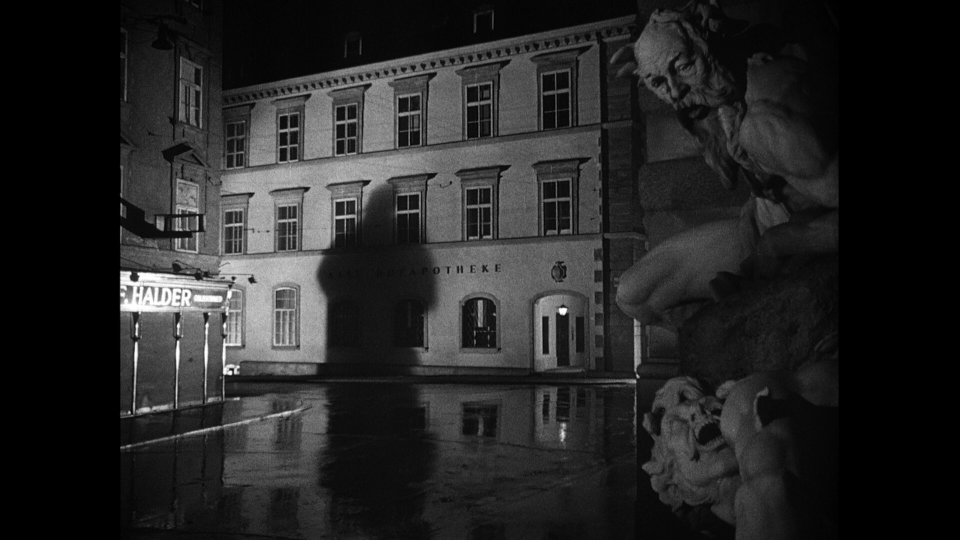
Fig. 5

Brief Encounter (1945) on the other hand was filmed using softer light (Fig 6,7). There are some similarities to The Third Man however, with shadows and some harsh light which makes for intense moments in the film (Fig. 6-9).

Fig.6

Fig.7

Fig.8

Fig.9

Although there are similarities between the two films Brief Encounter and The Third Man there are also similarities between “Brief Encounter”, “In the Mood for Love” (Fig. 10,11) and the photographs of Brasssai in his series “Paris by Night” (1936) (Fig.12). In Fig.11 from Brief Encounter the female face is softly but clearly lit while the male face is in the shadow, Fig.11 from ‘In the Mood for Love’ shows the same lighting being used along with a very similar framed shot.

Fig.10 In the Mood for Love

Fig.11 Brief Encounter

Fig.12

During my research, falling into the “Noir” genre was unavoidable although I didn’t want to go down that specific road. I am surprised at how much I’m getting out of the cinematography angle rather than the photographic. I think I have always tended to separate them in the past but now realise that that was a mistake!

When looking to set up and start planning some test shots, I was aware that trying to get the bright harsh light and potential strong shadows was going to be a challenge. I was relying on lamp light and other artificial lights for the softer shots. I came up with the idea of using car headlights, either from passing cars, if I can find the right location, or positioning my car so as to cast bright harsh light in the right direction.

I was surprised by my results for the first set of test shots. (Contact sheet 001)
I found a fairly open square that had different types of lighting and walls large enough to host shadows. I tried a variety of exposures so that I could compare them later. I also used the car headlights to throw some harsh, stronger light into the scene. This worked quite well and I used it to help create the shadows.
For image 0811 in contactSheet 001, I used a long exposure and asked a friend to walk under the lamp and away from me.
There was a fluorescent light on the other side of the arch which appeared very green (0773,0781,0782,)  I rather liked this effect so didn’t try and change it leaving the white balance on Auto 2 which was giving nice results for the lamps and the headlights. Some of the shots were overexposed and some under. It was difficult to focus at times due to the lack of light. I didn’t want the shots to be particularly grainy, so kept the ISO at 3600.

ContactSheet-001

Converting them to black and white changed the atmosphere of the images to something a bit more sinister. In colour they are softer without a particularly threatening edge.

ContactSheet-002

There were several sources of light which caused the main shadow  Images JLM0796 – JLM0800 to have a very indistinct edge, almost like movement blur. I was really looking for a stronger shadow.
I feel image 1 (JLM00811) has more impact in black and white. The wall and railings are clearer, leading the eye into the darkness. The figure blends better as he walks head down, into the darkness.

Img.1 _JLM0811BW 85mm, 1,3Sec, f/16, ISO 320

This was also the case for Img. 4 being in black and white, as it takes on a more sinister edge without the distraction of colour.

Img.4

Having looked at the initial images it occurred to me that because I had been influenced so much by film, I might unconciously be creating photographs that resemble film stills! Certainly Img.1 could have come from a movie. I like the fact that it is ambiguous and could be from movies of different genres. Romantic/Horror/Thriller………….
Doing a bit of research I came across a French science fiction still film by Chris Marker called La Jetee (1962) which is almost entirely made up of black and white photographs with a soundtrack and narrative. It was also the inspiration for the 1995 Terry Gillingham film “12 Monkeys”.
For this assignment it states that we are not required to create a story but I might be suggesting a story without meaning to!

For some of the shots I wasn’t able to control the light at all and had instead to use the light sources in different ways to create strong shadows and contrasting areas of light and dark.  (ContactSheet-003)

ContactSheet-003

The slow shutter speed has given the lamp a soft look and a whisper of a person leaving the scene on the left side (JLM0820). I converted this to black and white to see how it would sit with the previous images. (Img.5). Although I prefer the image in black and white I think they work as either.

Img.5

Another technique used in both “Brief Encounter” and the “The Third Man” was to tilt (Canted framing) the camera at moments of high tension or drama (Fig.13,14).

Fig.13

Fig.14 The Third Man

I gave this technique a go (Img.6)  but may have overdone the tilt!

Img.6

For my final selection I wanted a mix of images that had a strong shadow or some suggestion of movement. I also realised that I was selecting images that would illicit a very different emotion when viewed in colour or black and white.

Final selection:


_JLM0811BW

_JLM0933BW

_JLM0801BW

_JLM0891BW

_JLM0883BW

_JLM0820BW

_JLM0811

_JLM0933

_JLM0801

_JLM0891

_JLM0883

_JLM0820

Conclude your notes with a personal reflection on how you’ve developed the exercise in order to meet the descriptors of the Creativity criteria. Write 500–1,000 words.

Part four of this course has been the most difficult so far. Finding a personnel voice and being creative is a hard thing to judge. Using film as my inspiration may possibly have limited my voice but I enjoyed looking at the films with a fresh perspective, appreciating how they had been shot and learning the techniques cinematographers used to illicit feelings.

The idea of producing a set of images that would illicit emotions developed as I worked my way through the assignment, and in the exercise on the quality of light in particular. I became very conscious of how the colour, intensity and angle of the light can change an image.

I was keen not to pre-determine what form the images would take, but rather to find interesting locations with dramatic light sources, and to produce images that were a response to each. At he beginning of this assignment I wrote “For the assignment I wondered if it would be possible to look for streets, where something about the location itself allows some additional creativity?” This was in response to the way Christopher Doyle came up with some of the scenes in the film “In the mood for love”. Looking back at my images there is no doubt that the locations made them. Although I had plenty of ideas in my head about what images I wanted, many of them came about because the location allowed for more creativity than I had imagined. For example, the shadow on the foreground wall in image JLM0993 allowed me to include the illuminated background wall and steps, which gave depth and direction whilst the fluorescent light causing a strong green colour through the arch (ContactSheet-001)

My starting point was the capture of the human shadows, which is not itself original, but I feel I introduced imagination and creativity by omitting the subject casting the shadows, by the placement of the shadows in the frame, and by changing the angles from which the images were shot from. I also intentionally selected images that had a shadow of a person, a person or none at all. I wanted the viewer to actively  seek a human presence in the image where it was actually missing.
So, in image JLM0891 for example, I disguised the shadow in the strong verticals caused by the different lights shining on the walls with the intention that it would not be noticed immediately. This worked rather too well on one occasion when I opened the image and the shadow made me jump, as I had forgotten it was there!. The opposite is true for image JLM0883 where I was happy for the shadow to be the first thing you notice.
Similarly, in image JLM0881, by using a slow shutter speed and asking my subject to walk away from the camera, I was able to capture a strong figure but with blurred feet. Having the person walk into the dark part of the car park, gave the image a dark feeling.

Although the brief states that “this is not a narrative assignment – you’re not required to produce a story”, I realised that a different story could be present in the black and white and the colour images. This led me to wonder that if people were asked to come up with a narrative when looking at the sets of images, if or how much the narrative would differ depending on which set they were looking at. I don’t have time to pursue this idea for this assignment but will set it up as an ongoing project.

Having selected my final set of images I was left with the difficult task of deciding on black and white or colour. Rather than take this decision, I decided to include both to celebrate the fact that the different versions of the photos suggested different moods, and in turn different stories.

It is becoming clear to me that the course as a whole is having a strong influence on my photography. It has enhanced my technical skills, my ability to read photographs, and my knowledge of other photographers and the techniques they adopted in their work. I am building on the skills and concepts I have learned and understand ideas at a much deeper level. In performing this part of the course I adopted an approach and techniques that I think allowed me to produce my own images, but images I would, and indeed could, not have created before.

Additional Material and some re -working after feedback from tutor.

My Tutor feedback was really helpful and was centered mainly around keeping the series tight and some aspects of framing. He also mentioned that he like the fact that I had given the colour plenty of “space”. I had done this unconsciously but on reviewing the images I really understood what he meant. I do find it very hard to communicate why I like or indeed why I dislike an image (either mine or someone else’s) but I have no doubt that I chose some of the images for the space (which was full of the lovely golden yellow hue) as well as the objects in the space.
When I look through the viewfinder or review images I have taken on a screen for the first time , It is often just a feeling I get, rather than any conscious analytical process. I’m sure that I tend to dwell on the object more than the space, which in hindsight isn’t always the best way and something I will be addressing in future images.

One of my biggest issues during this course has been around creating a cohesive series and although I do feel like I have improved, I still tend to view the images individually instead of as a series.  It was suggested in my feedback that I have a look at Rut Blees Luxemburg ‘Liebesleid’, Rut Blees Luxemburg in conversation with David Campany and the film ‘Only Lovers Left Alive’ by Jim Jarmusch in relation to the colour of my images. Although I had already looked at Luxemburg work in a previous exercise I had not been aware of how closely some of my images resembled the colour and content found in her images (Fig 15 and JLM0806). There was no intent at the time to use these as influence for this assignment, although in hindsight I suspect I should have made the connection.  Luxemburg born in 1967 is a German photographer who takes images at night using large a large format camera and long exposures.

The photograph that I took at the end of exercise (Img.16), the one that inspired this assignment, is reminiscent of several of Rut Blees Luxemburg’s images. In particular the colour and wet footprints visible in “In deeper” (Fig. 16)

Fig.15 Liebeslied 1997, Rut Blees Luxemburg

JLM0806

Img.16

Fig.16 Rut-Blees-Luxemburg_InDeeper

Rut Blees Luxembourg talks about space. In an interview with David Campany in 1999, she states “I am attracted to the Heimlichkeit of a space in public. A space that allows for a moment of repose”
(Campany, 2014)
Taking street, city or town  images at night is a very different experience from going out during the day. Generally it is quieter (I guess that depends on the location) and I found that very much the case when I was taking my night time shots. I used 2 locations, one which is a small hill top village in Italy and another larger more industrial town also in Italy. The shots were taken in the winter later in the evening which meant there were very few people around.  To date I hadn’t had the opportunity to wander these streets at this time of night in winter time and I was fascinated how different the places seemed.
In the summer the hill top village is teaming with locals and tourists and one would have to wait for the very early hours of the morning to get the peace and quiet of empty streets and squares. I do love wandering around places and often will wander without my camera prior to shooting a project. I was interested to note that the theme of wandering came up several time in Luxembourg’s interview with Campaney when discussing the image In Deeper (Fig.16).
“And here a very golden quality to water as it is lit. This image is also very much about absence. You see the footsteps on the mud? They are expressive of something that runs right through the Liebeslied series, which became about a possible poet who is wandering the city in a way that is in contrast to the flâneur made famous by Baudelaire. The flâneur’s relation to the city is very much about a pleasure or diversion. The poet’s wandering is more about an encounter” and “I do walk alone although occasionally when I come to shoot on large format I’ll take an assistant, but by that stage the wandering has been done”
(Campany, 2014).
I would really like my images to have a feel of solitude and space, particularity in locations where normally there is a lot of activity and people.

After some thought, discussion and the feedback from my tutor I have decided on the following re work.

  • Remove image 0811 on the grounds that it doesn’t sit well with the rest of the images in relation to content and colour. Shoot alternative.
  • Retake and reframe image 0820 to include more space in front of the steps and exclude lamppost (keeping lamppost shadow)
  • Retake image 0883 without shadow
  • Retake image 0891 without shadow
  • Retake image 0801 with smaller aperture to ensure all areas are sharp
  • Find alternative image for 0933

Removing the human shadow from the colour set is a conscious decision based upon the fact that they don’t really enhance the images in any way. In fact they interfere with the space which I have now see as being what the images can be about. This isn’t necessarily true for the black and white images where the human shadows give them something dark and threatening.

The above plans for re taking some of the images has been put on hold due to the covid-19 lockdown situation. I have no idea when I will be able to re visit the locations in Italy so have decided to have a look at all the original images I took for the assignment and see if any of them are suitable in light of my scuppered plans. I will also look at using Photoshop to edit where appropriate.

For the colour images:

  • Remove image 0811 on the grounds that it doesn’t sit well with the rest of the images in relation to content and colour.
  • Take lamppost and shadow out of image 0820 using photoshop.
  • Take shadow out of image 0883 using photoshop.
  • Take shadow out of image 0891using photoshop.
  • Sharpen image 0801 in photoshop
  • Take the shadow and distracting alarm and wires out of image 0933 using photoshop

As I currently be able to retake the shots I won’t be able to reframe image 0820 to allow more space in the foreground.

Most of the feedback was in relation to the colour set. I was quite confused about which set to submit initially and it was only when I received the feedback and discussed it with my tutor did I realise how very different the sets were. The colour set is just that. It is all about colour and space. This renders the shadows unnecessary and distracting.
For the black and white images I feel the shadows do give them a sense of mystery and make them more noirish. Image 0811 sits better in this set so I intend to leave it in.

Re-worked colour set

In the feedback my tutor had commented on the green and gold “In a series keep things tight – if it’s gold and green, stick to that throughout”.  I can now see what he meant and it is now far more apparent that images 0883, 0820 and 0801 sit well together with the green and gold hues. (The green is not quite so apparent in 0801)
Without the shadows there is more space to appreciate the colour and space.
In image 0820 the space has allowed colour to jump out but unfortunately showed up the tight crop even more than before.

0820

0883

0801

0933

0891


Bibliography

Christopher Doyle methods
At:https://www.youtube.com/watch?v=iDMRB5cCrzY
[Accessed 02/12/2020]

Figure 1
At: http://internationalcinemareview.blogspot.com/search?q=hitchcock+the+wrong+man
[Accessed 10/01/2020]

Figure 2
At: https://www.theguardian.com/film/filmblog/2013/nov/29/top-10-film-noir
[Accessed 14/01/2020]

Figure 3
At: https://www.imdb.com/title/tt0041959/mediaviewer/rm1999096832
[Accessed 19/01/2020]

Figure 4
At: https://ogsmoviereviews.files.wordpress.com/2012/01/screenshot-lrg-25.png
[Accessed 19/01/2020]

Figure 5-9
At: https://www.bfi.org.uk/news-opinion/news-bfi/features/location-location-location-vienna-third-man
[Accessed 20/01/2020]

Figure 10
At: https://www.indiewire.com/2012/12/watch-bbc-docu-about-christopher-doyle-his-work-on-in-the-mood-for-love-chungking-express-more-103091/
[Accessed 01/12/2019]

Figure 11
At: https://www.criterion.com/films/345-brief-encounter
[Accessed 20/01/2020]

Figure 12
At: https://americansuburbx.com/2012/05/brassai-paris-by-night.html
[Accessed 01/12/2019]

Figure 13
At: https://slideplayer.com/slide/9870706/
[Accessed 23/01/2020]

Figure 14
At: http://pcafilmscreenings.blogspot.com/2016/12/the-third-man.html
[Accessed 23/01/2020]

Figure 15
At: https://rutbleesluxemburg.com/liebeslied-2.html
[Accessed 18/02/2020]

Campany, D. (2014). Art and photography. London: Phaidon.